
Living Room Accent Chair Ideas: How to Choose and Place a Statement Seat
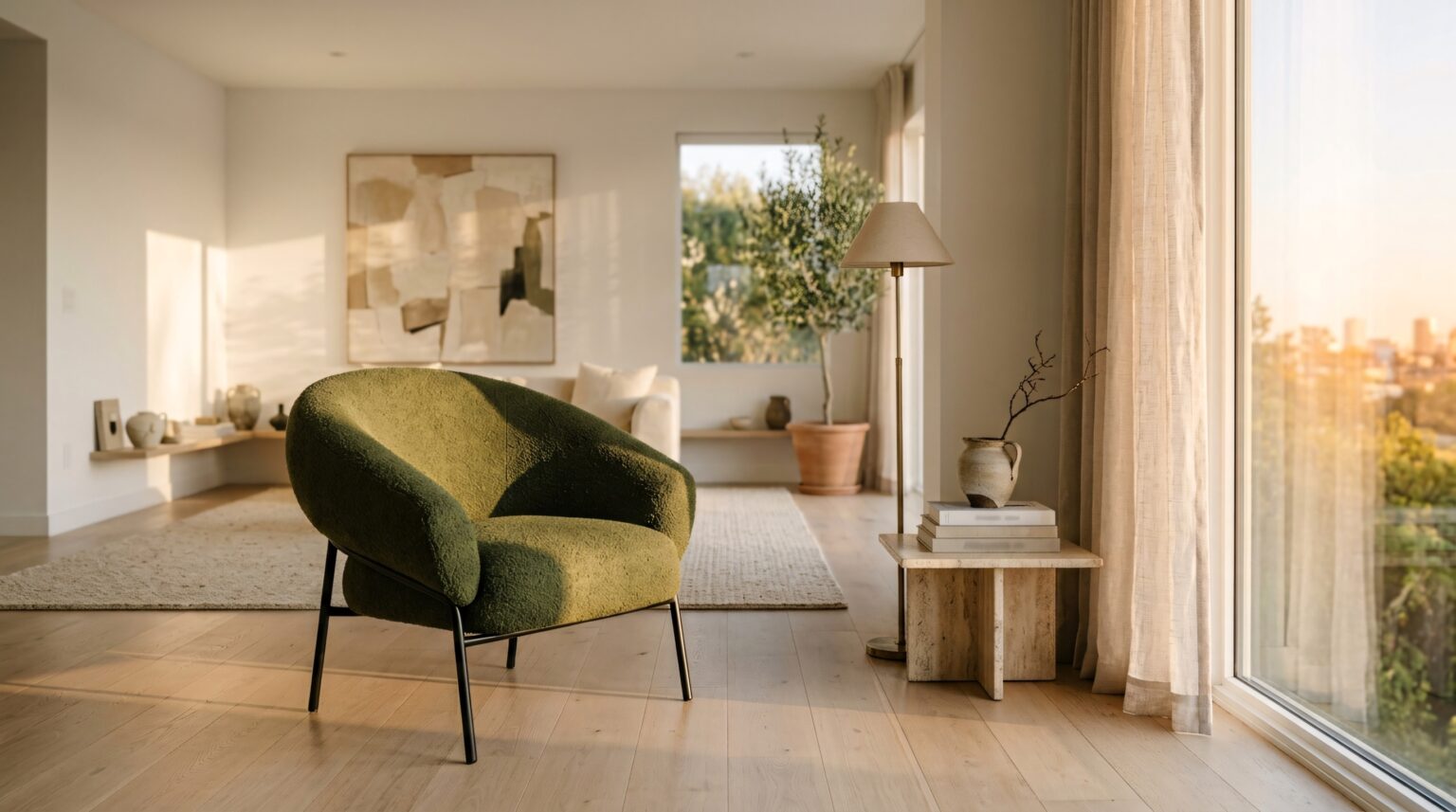
There is a particular kind of morning light that finds its way into a living room and settles, uninvited, into the folds of a single chair. It catches the curve of a bouclé back, pools along a tubular steel leg, and for a moment, the whole room seems to organize itself around that one piece of furniture.
This is the quiet power of a statement seat. Not a filler piece. Not an afterthought pulled from a clearance aisle. A chair that holds its own gravity — sculptural enough to catch the eye, tactile enough to invite the hand, grounded enough to feel like it was always meant to live exactly there.
Choosing one is less about furniture shopping and more about editing a feeling into place. What follows is everything that separates a chair that merely fits from one that finishes the room.
“Apex Illume is reader-supported. When you purchase through links on our site, we may earn an affiliate commission at no extra cost to you.”
Finding the Right Scale — Size Cues That Make a Chair Feel Considered
Scale is the difference between a chair that feels inevitable and one that feels apologetic. Get it right, and the eye never questions it. Get it wrong, and no fabric or finish will save it.
Seat Height and Sofa Harmony
Accent chairs flatter a room most when they sit within an inch or two of the sofa’s seat height — typically 17 to 19 inches from the floor. A low-slung silhouette like the Ella Lounge Chair with Tubular Legs, at 27.4 inches overall height, feels grounded rather than perched, settling into a sofa’s sightline instead of interrupting it. A side table topped with a soft glow — the kind cast by Travertine Table Lamps — can help bridge that height visually, tying the chair’s silhouette to the rest of the seating arrangement.
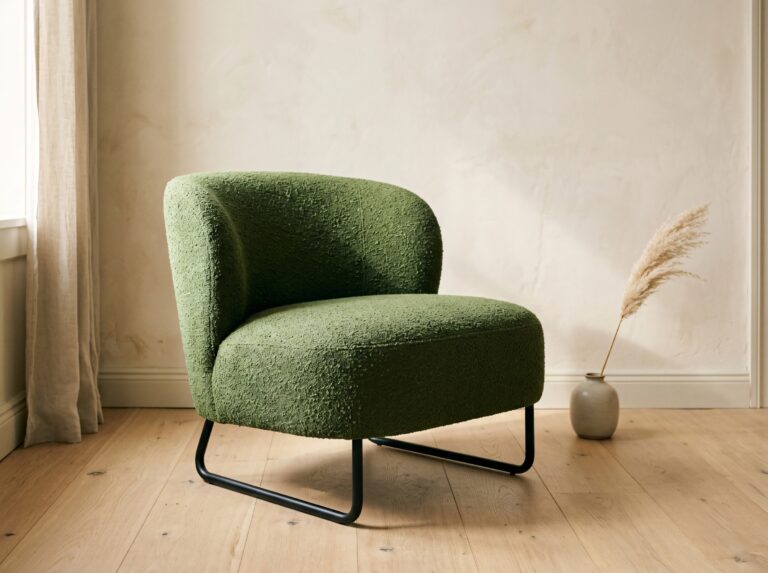
Ella Lounge Chair with Tubular Legs
Case Furniture
steel base – Moss Bouclé
Proportion Rules for Width, Depth, and Arm Height
A chair’s width and depth should feel proportionate to the body sitting in it, not to the empty square footage around it. A generous 30- to 34-inch width feels substantial without becoming a second sofa. Arm height matters more than most realize — arms that hit just below elbow level feel supportive; arms that rise too high make the whole piece feel boxy and stiff. The goal is a frame that looks as though it was drawn specifically for the room, not selected from a catalog of approximations.
Where the Chair Belongs — Placement That Invites Conversation
A beautiful chair in the wrong spot becomes a beautiful obstacle. Placement is where design intention either holds or collapses.
Angled Toward the Sofa
Angling a chair slightly toward the sofa, rather than facing it head-on, creates the most natural conversational geometry. This soft diagonal invites conversation without demanding it — a posture, not a confrontation.
Anchoring a Window, Fireplace, or Reading Nook
Some chairs aren’t meant to converse at all. They’re meant to anchor a quieter corner — beside a window where the light pools in the afternoon, or near a fireplace where warmth and stillness intersect. In these settings, Ambient Corner Lighting does quiet work, softening the edges of the nook after the sun retreats and giving the chair a reason to be occupied well into evening.
Keeping Traffic Paths Clear
No chair, however sculptural, earns its place if it interrupts the room’s natural rhythm. Leave at least 30 inches of clearance for walking paths. A chair that requires visitors to navigate around it like an obstacle course was placed in haste, not with intention.
Matching, Mixing, or Contrasting With Your Sofa
The question isn’t whether to match — it’s whether matching serves the room’s larger story.
When Symmetry Wins
In rooms with formal proportions — high ceilings, symmetrical windows, a fireplace as centerpiece — matching upholstery between chair and sofa creates a calm, cohesive backdrop. This works especially well when the room already carries visual complexity elsewhere: layered textiles, a bold rug, an active gallery wall.
When Contrast Adds Character
In more relaxed or eclectic spaces, contrast becomes the more interesting choice. A sofa in soft linen paired with a chair in rich, saturated bouclé feels intentional rather than chaotic — as long as the two pieces share a common thread, whether that’s a wood tone, a metal finish, or a shared undertone in color palette.
Choosing an Upholstery That Lives as Beautifully as It Looks
Fabric is where aspiration meets daily life. Even the most beautiful chair in the room still has to survive it.
Performance Velvet for Depth and Durability
Performance velvet delivers the visual richness of traditional velvet — deep color saturation, a soft sheen that shifts with the light — without sacrificing durability. Treated fibers resist staining and crushing, making it a rare fabric that photographs beautifully and holds up to actual living.
Leather for Patina and Ease
Leather ages instead of wearing out. Each year adds character rather than damage, and the material only asks for the occasional wipe-down in return. It suits rooms that want warmth with minimal upkeep — a chair that becomes more interesting, not more tired, with time.
Bouclé for Texture-Forward Softness
Bouclé brings a tactile softness that feels hushed and opulent rather than fussy. Its nubby texture hides minor wear beautifully, though it’s better suited to lower-traffic corners than to a chair fielding daily use from kids or pets. The Ella Lounge Chair with Tubular Legs, upholstered in Moss Bouclé over a curved, low-slung frame with a tubular steel base, is a study in this restraint — 30.6 inches wide, 28.7 deep, and priced at $1,385 through 2Modern. It’s the kind of chair that photographs like sculpture and feels like a favor to whoever sits in it.
Small-Space Accent Chair Ideas That Preserve Flow
A small room doesn’t have to forgo a statement — it simply requires a lighter hand.
Leggy Frames and Slim Silhouettes
Chairs with exposed wood or metal legs let light pass beneath them, visually expanding the floor space. Paired with slim, tapered arms, these frames deliver presence without density — the visual equivalent of a room that can still breathe.
Compact Swivels as Space-Savers
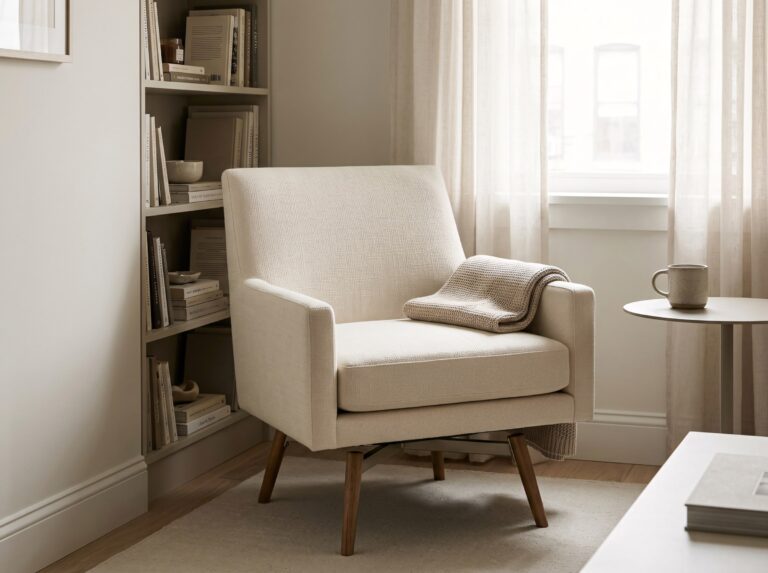
A compact swivel chair solves a problem most small rooms face: not enough distinct zones. The Banks Swivel Chair answers this directly — just 27 inches wide, with slim arms and a full 360° swivel base, available in performance fabric neutrals like Cambric Ivory and Alcala Taupe, or in top-grain leather. Priced from $719.20 through 2Modern, it rotates toward the window by day and the fireplace by night, doing the work of two chairs without asking for two chairs’ worth of space.
Banks Swivel Chair
Four Hands
offered in performance fabric neutrals Cambric Ivory (90% polyester/10% flax) and Alcala Taupe (70% polyester/20% viscose/10% flax), plus top-grain leather option.
Pairing Two Accent Chairs With a Sofa or Sectional
Two chairs, arranged with purpose, can do more for a room’s balance than any single piece.
Mirrored Pairs Opposite the Sofa
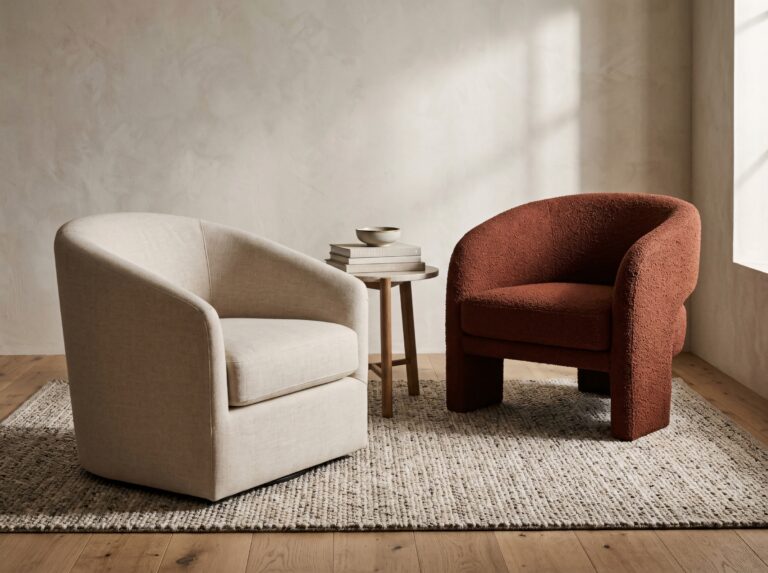
Identical chairs placed opposite the sofa create instant symmetry — the classic, editorial living room arrangement. A pair of the Inaya Modern Accent Chair, with its simple rounded tub silhouette and linen upholstery in Ivory, Cream, or Grey, suits this arrangement particularly well; its understated shape lets it repeat across a room without ever feeling redundant. Priced between $580.14 and $638.19 through Lumens, it’s a quietly opulent way to fill two spots with one confident decision.
Inaya Modern Accent Chair
Alder & Ore
linen upholstery available in neutral tones (Ivory, Cream, Grey)
Offset Arrangements With a Shared Ottoman
For a softer, more lived-in feel, offset the two chairs at gentle angles and unite them with a single shared ottoman. This arrangement invites movement and flexibility — ideal for rooms that shift between quiet reading and full conversation.
Keeping Heights and Lines Cohesive
Whichever arrangement you choose, keep seat heights and arm lines consistent between the two chairs. Visual rhyme matters more than identical fabric — a pair of chairs in complementary tones but matching proportions will always feel purposeful together, especially when styled beneath a gallery wall arrangement, like the layouts explored in Gallery Wall Ideas (coming soon to the Decor journal).
Swivel or Stationary — Choosing for a Multi-Focal Room
Not every room asks its seating to stay still.
When a Swivel Earns Its Footprint
Rooms with more than one focal point — a fireplace on one wall, a television on another, a window view begging for attention — benefit enormously from a swivel base. A chair like the Banks Swivel Chair becomes an adaptable vantage point rather than a fixed commitment, turning toward whatever the room asks of it that hour.
When a Fixed Frame Feels More Grounded
In rooms built around a single, clear focal point, a stationary frame feels more settled — less like a solution to indecision and more like a deliberate anchor. The Inaya Modern Accent Chair, with its fixed tub-shaped base, suits this kind of room: a reading corner, a fireside seat, a spot that doesn’t need to look anywhere but where it already faces.
Color and Pattern — Making the Chair a Focal Point Without Clashing
Color is where the chair either sings or shouts. The difference lies in restraint.
Tonal Layering vs. Deliberate Contrast
A chair in a tone closely related to the room’s existing palette adds richness without visual noise — this is tonal layering at its most sophisticated. A moss-toned bouclé chair against warm neutrals, for instance, deepens a room rather than interrupting it. A chair in bold, deliberate contrast, on the other hand, becomes the room’s focal note. Both strategies work; the failure mode is landing accidentally in between.
Applying the 60-30-10 Rule
A dependable framework: 60 percent dominant color (walls, large upholstery), 30 percent secondary color (rugs, drapery), and 10 percent accent — often the chair itself. This ratio keeps a bold chair from overwhelming the room while still letting it command attention.
Pulling Hues From Rug, Art, or Drapery
Effortless color choices are rarely invented from scratch. Pull a hue directly from an existing rug, a piece of art, or a drapery panel, and the chair will feel like it was born from the room rather than introduced to it.
There’s a particular satisfaction in walking into a living room and feeling, before you can articulate why, that everything belongs. The rug sets the tone. The light does its slow work in the corners. And the chair — sculptural, tactile, exactly the right height and hue — holds the room together like a closing thought.
A single seat, chosen with this much intention, rarely reads as furniture. It reads as instinct. Explore the pieces we return to again and again, and let one chair do the work of finishing a room.