
Statement Couch Ideas: How to Choose a Sculptural Sofa for Your Living Room
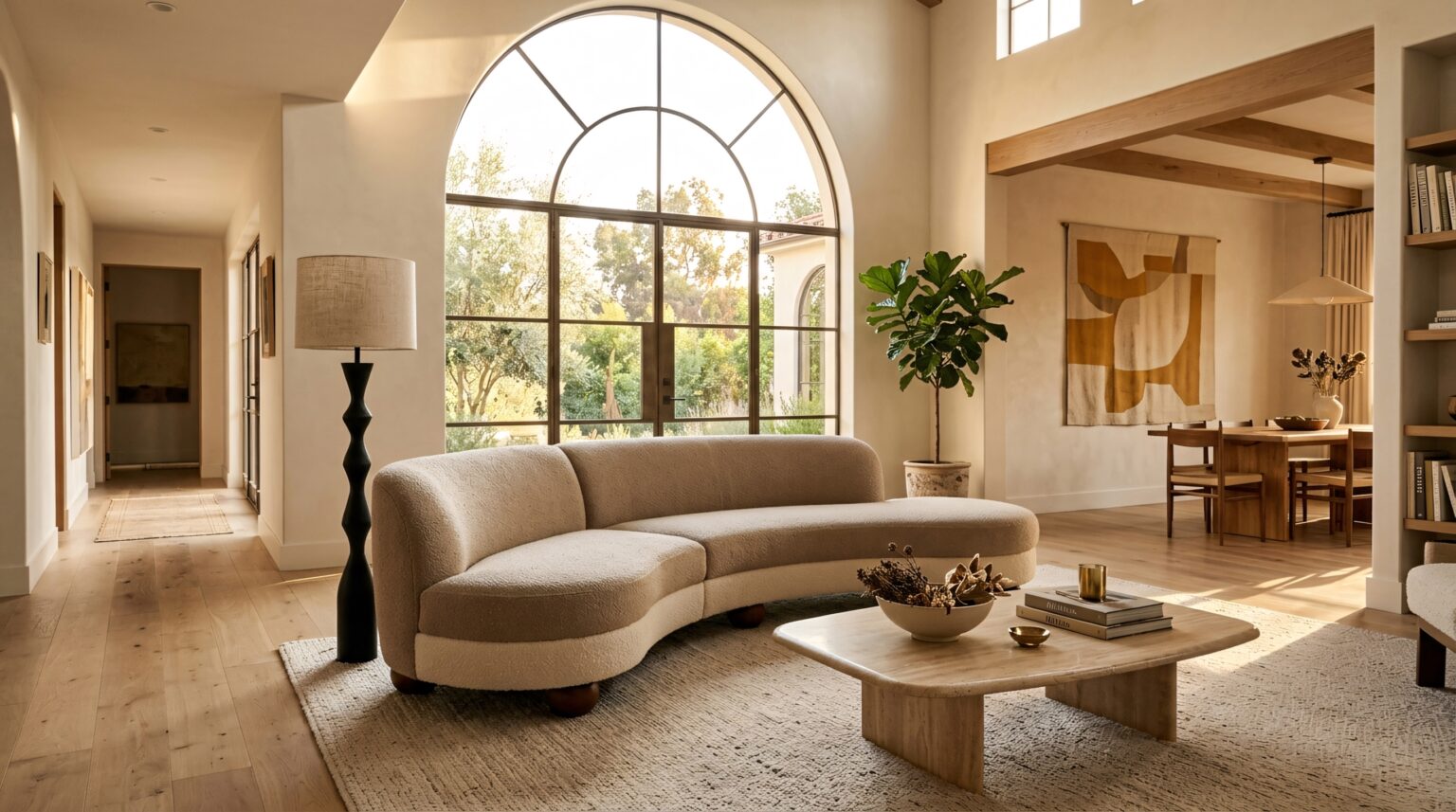
Walk into a room built around one confident curve, and the eye doesn’t wander — it settles. Before the rug registers, before the art on the wall announces itself, the sofa has already made its case. This is what a true statement couch does. It doesn’t wait to be noticed. It reorganizes the room around itself, quietly and completely.
A sofa this size was always going to be the room’s largest object. The question is whether it becomes its center of gravity — the piece everything else is arranged in relation to — or simply its biggest piece of furniture. The difference lies entirely in the choices that follow.
“Apex Illume is reader-supported. When you purchase through links on our site, we may earn an affiliate commission at no extra cost to you.”
Finding the Right Fit — Scale and Silhouette Before Anything Else
A sculptural sofa asks more of a room than a standard one. Getting the scale right is what separates a statement from a squeeze.
Reading Curve vs. Straight in Your Actual Room
Curves soften a room’s geometry, lending it a more sculptural quality — but they demand a slightly different kind of space, one where the eye can trace the sofa’s arc without hitting a wall too soon. Straight silhouettes, by contrast, tuck more efficiently into corners and defined room edges. Neither is superior; the room dictates the answer.
Seat Depth and Scale Cues That Prevent Overwhelm
A seat depth beyond 24 inches starts to feel generous rather than gracious — lovely for lounging, less forgiving in a smaller footprint. Measure the room’s clear floor space before falling for a silhouette, and remember that a sculptural shape needs breathing room on all sides to feel like sculpture rather than obstruction.
Testing a Curved Silhouette Before You Commit
Painter’s tape on the floor remains the simplest way to test a curve. Trace the sofa’s actual footprint — arc included — and live with it for a few days. A curve that looked effortless in a showroom can behave differently once it’s negotiating with a doorway or a window seat.
Curved, Sectional, or Straight — Which Shape Earns Its Place
Every room has a shape it wants to be filled with. The work is in listening for it.
Curved Sofas for Open-Plan Flow
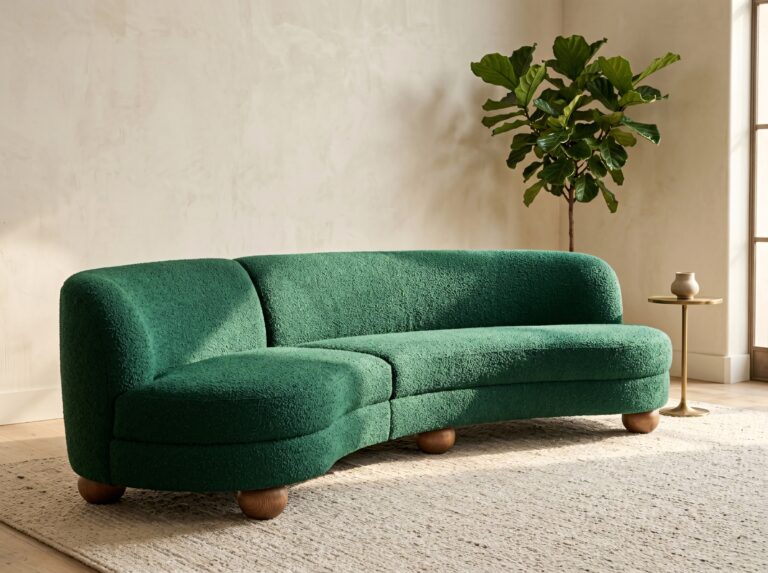
In open-plan rooms, a curved sofa softens the transition between zones — living, dining, entry — without the hard stop of a squared-off arm. The Caracole Tulum 3-Seater Sofa exemplifies this ease: a gently curved frame in two-tone bouclé, set on rounded ash feet, at 90 inches wide and 31 inches high. It behaves like sculpture first, seating second — precisely the effect an open floor plan rewards. Priced at $3,900 through 2Modern, it lets a room breathe around it rather than close in.
Caracole Tulum 3-Seater Sofa
2modern
two‑tone bouclé fabric with rounded wood feet
Sectionals for Anchoring Larger Rooms
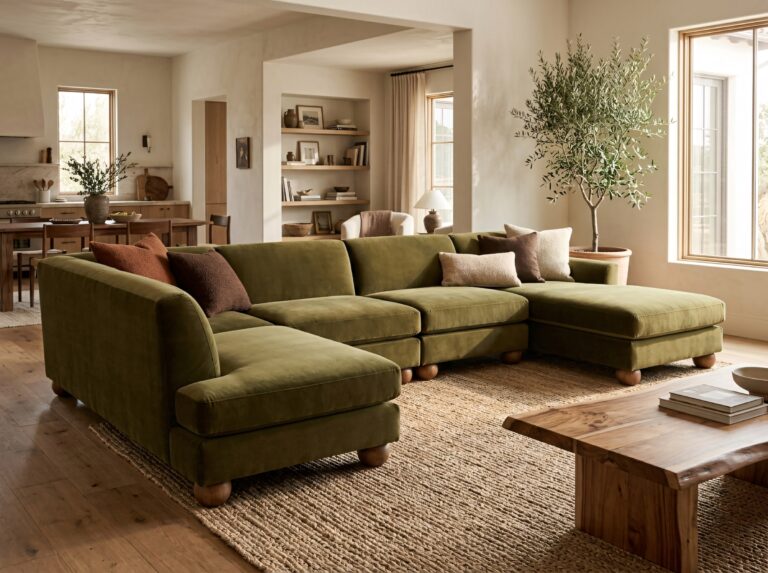
Larger rooms with real seating demands call for a sectional with structural presence. The Four Hands Phillip 2PC RAF Sectional in Surrey Olive Performance Velvet answers this precisely: an L-shaped, 119-inch-wide silhouette with a 24-inch seat depth and sinuous-spring support, upholstered in a deep, grounded olive velvet. At $4,964 through Perigold, it anchors a room the way only a piece of this scale can — substantial without tipping into bulk.
Four Hands Phillip 2PC RAF Sectional in Surrey Olive Performance Velvet
Perigold
two‑tone bouclé fabric with rounded wood feet
Straight Silhouettes for Small or Formal Spaces
A straight-backed sofa often feels more settled than a curve fighting for space it doesn’t have — which is precisely why smaller or more formal rooms tend to favor it. Clean lines suit spaces where symmetry matters more than sculptural drama.
Upholstery That Lives as Boldly as It Looks
A statement couch has to survive its own statement. Fabric is where that promise is kept or broken.
Performance Velvet for Depth Without Delicacy
Performance velvet delivers the visual richness of traditional velvet — a deep, light-shifting nap — without the fragility. Treated fibers resist staining and crushing, which matters enormously on a piece fielding this much daily use. The Surrey Olive velvet on the Four Hands Phillip sectional makes the case clearly: a hue and texture rich enough to anchor a room, resilient enough not to demand babying.
Leather for Ease and Patina
Leather ages rather than wears out, gaining character with each year instead of losing it. It suits a statement couch that wants warmth and minimal upkeep in equal measure — a piece that only grows more interesting with time.
Bouclé for Texture-Forward Softness
Bouclé brings a tactile, quietly opulent texture that photographs beautifully and forgives the small scuffs of daily life. The two-tone bouclé on the Caracole Tulum Sofa uses this to full advantage — texture doing as much visual work as the curve itself.
Color Confidence — Choosing a Hue You Won't Outgrow
A bold color commitment on a piece this size deserves more thought than a swatch glanced at under store lighting.
Reading Jade, Rust, and Cobalt in Real Light
Saturated hues shift dramatically between showroom lighting and home lighting. Jade can slip toward gray in low light; rust can turn nearly terracotta at midday. Always view a fabric swatch in the actual room, at the actual hours it will be lived in, before committing.
A Simple Framework for Long-View Color Decisions
The safest long-view strategy: choose a hue you’d still want to see in five years of photographs. Trends cycle quickly; a color chosen because it feels inevitable — not merely fashionable — tends to outlast them. A grounded tone like olive performance velvet, or a soft neutral bouclé, both pass this test by leaning timeless over of-the-moment.
Styling the Room Around the Sofa — Not the Other Way Around
Once the sofa is chosen, everything else in the room exists in relation to it.
Rug and Coffee Table Proportions for Curved or Sculptural Shapes
A curved sofa pairs naturally with round or oval coffee tables — the shared geometry keeps the room’s lines in conversation rather than conflict. Rugs should extend a few inches beyond the sofa’s front legs, keeping the piece visually tethered without cutting it off at the knees.
Art and Wall Styling That Complements Without Competing
The space above a statement couch is prime real estate, and a gallery wall arrangement is one of the most requested ways to fill it. Done well, it draws the eye upward without pulling attention from the sofa’s shape below — a layering technique explored in more depth in Gallery Wall Ideas (coming soon to the Decor journal).
Texture-Mixing That Keeps the Sofa as the Hero
Layering textures — a woven throw, a mix of pillow fabrics, a nubby rug underfoot — adds depth without visual competition. A few well-chosen throw pillows, arranged with intention rather than symmetry, can echo the sofa’s palette while letting it remain the room’s clear focal point; see Throw Pillow Arrangement (coming soon to the Decor journal) for pairing logic.
Where the Statement Couch Belongs — Floating vs. Against the Wall
Placement determines whether a sculptural sofa gets to perform or simply gets pushed into a corner.
Floating a Curved Sofa for Maximum Impact
Curved sofas come alive when floated away from the wall — the shape needs space on both sides to feel intentional rather than accidental. A sofa this shape becomes the room’s centerpiece, especially in open-plan layouts. A sculptural floor lamp beside it fills the vertical space a floated piece leaves behind, standing in for the wall-mounted lighting a backed-up sofa would otherwise rely on — a pairing worth exploring in Sculptural Floor Lamps.
When Anchoring to a Wall Makes More Sense
Straight silhouettes and structured sectionals often feel more resolved anchored to a wall — particularly in smaller rooms where floor space is at a premium. The Four Hands Phillip sectional, given its scale, tends to work best backed against a wall, freeing the room’s remaining footprint for movement.
Keeping Pathways Open Around a Bold Shape
Regardless of placement, maintain at least 30 inches of clearance for walking paths. A sculptural sofa loses its impact entirely if visitors have to navigate around it like an obstacle.
Small-Space Statement Couch Ideas That Don't Overwhelm
A small room doesn’t disqualify a statement — it simply calls for restraint in scale, not ambition.
Compact Curves and Leggy Frames
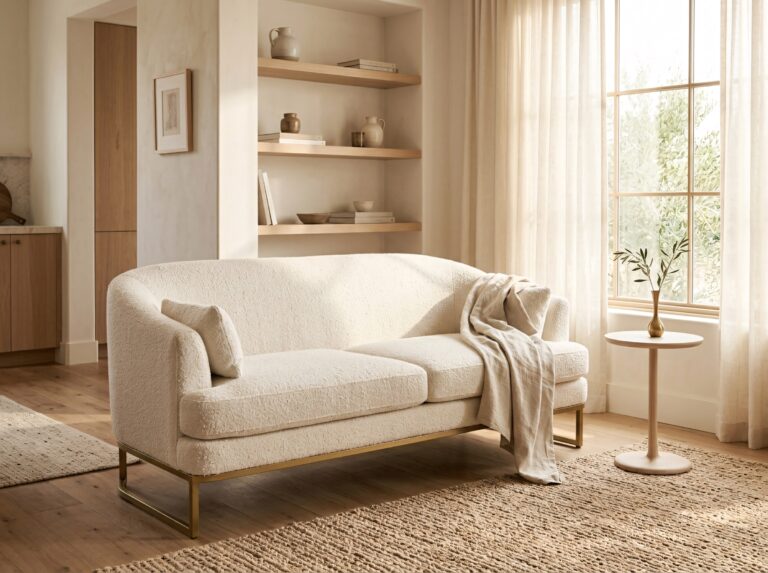
A smaller curved silhouette on a slim, exposed base delivers sculptural presence without visual density. The Normann Copenhagen Rar 2-Seater Sofa in Venezia off-white does exactly this: 67.13 inches wide, set on a slim powder-coated steel base, upholstered in a soft linen-blend fabric. At $2,341 through Finnish Design Shop, it brings sculptural confidence into a footprint that respects a smaller room’s limits.
Normann Copenhagen Rar 2-Seater Sofa
Finnish Design Shop
Surrey Olive performance velvet –
Light-Handed Styling That Preserves Airiness
Restraint in styling matters as much as restraint in scale when the room is small. A single textured throw, one considered pillow pairing, and a rug sized to the room — not the sofa — keep a compact statement piece feeling open rather than crowded.
There’s a particular kind of quiet that settles into a room once the sofa is finally right — not loud, not overdone, simply resolved. The curve holds its line. The color holds exactly as intended in the afternoon light. And the room, once uncertain, now carries itself with confidence.
A single sculptural sofa, chosen well, rarely announces itself as furniture. It reads as instinct. Explore the pieces we return to again and again, and let one shape define the room’s center of gravity.