
Mirror Decorating Ideas: How to Use Mirrors to Open Up and Elevate a Room
By Mabrouk Mhamdi · Curator at Apex Illume
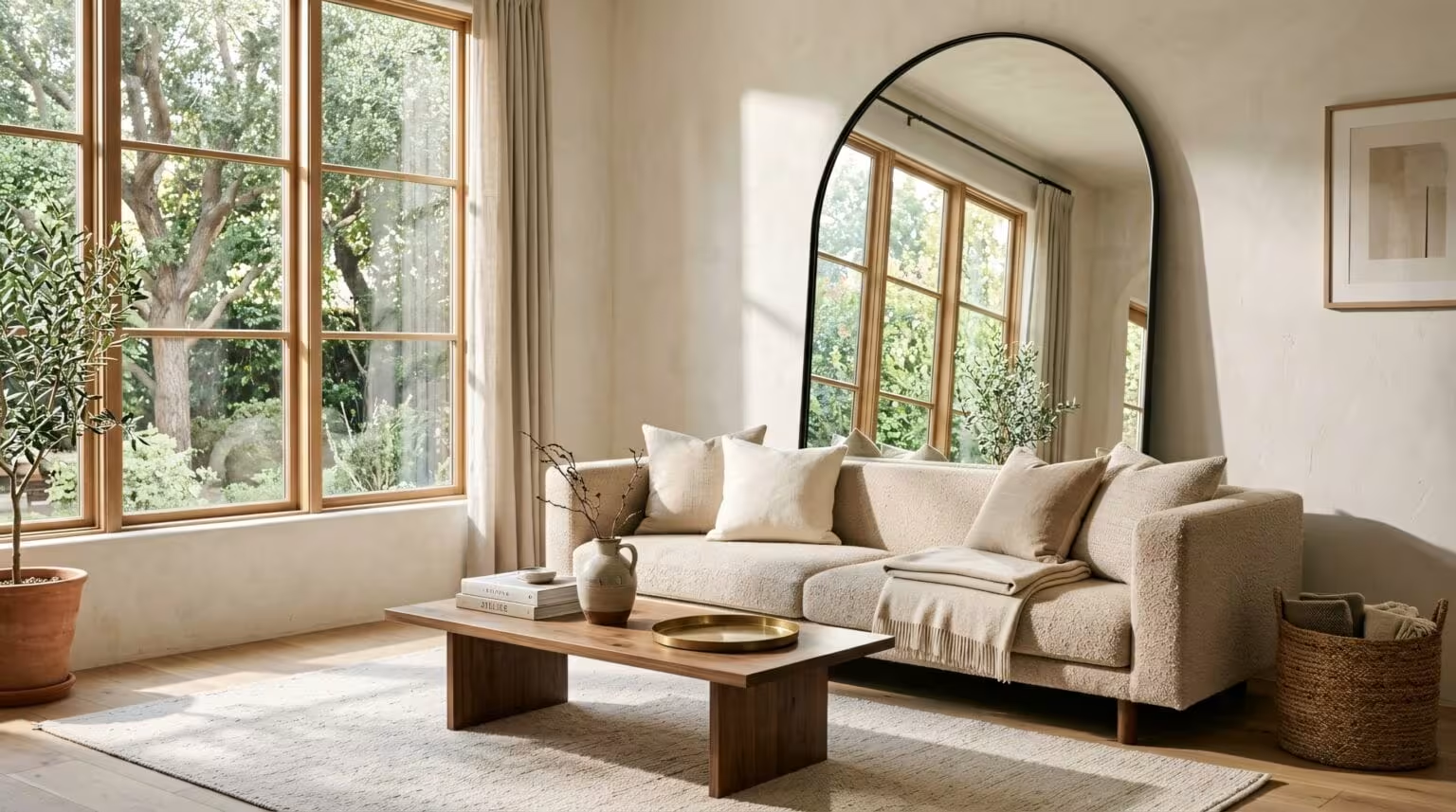
Morning light hits the mirror at just the right angle and doubles itself across the room — spilling over the console, climbing the opposite wall, filling a hallway that suddenly feels wider than its actual walls. Nothing physical has changed. The square footage remains exactly what it was. And yet the room breathes differently.
This is the quiet magic of a mirror, and no other object in a home works this hard while asking for so little. It is pure function dressed as pure style — the rare piece that can transform a room’s entire sense of scale without a single wall coming down.
“Apex Illume is reader-supported. When you purchase through links on our site, we may earn an affiliate commission at no extra cost to you.”
How We Chose These Mirror Ideas (and the Featured Pieces)
A mirror earns its place when it does more than reflect—it redirects light, corrects proportions, and quietly finishes a wall that felt unresolved. For this guide, I prioritized placements that change how a room behaves (not just how it looks): mirrors that bounce natural light, soften tight geometry, and create a focal point without visual noise.
When specific mirrors are featured, they’re selected for proportion, silhouette, and frame restraint—pieces that can live in a room for years without feeling like a trend.
How Mirrors Bounce Light and Make Small Spaces Feel Bigger
Before style enters the conversation, a mirror’s first job is physics: it moves light around a room that would otherwise trap it in one corner.
Placement That Maximizes Natural Light
A mirror hung perpendicular to a window catches daylight at its most active angle, throwing it across the room rather than simply reflecting the glass back at itself. This single placement decision often does more for a room’s brightness than an additional light fixture ever could.
Reflecting Ambient Light After Dark
At night, a mirror positioned to catch a lamp’s glow doubles that light’s effective reach — turning one warm source into what feels like two, without adding another fixture or another watt to the electric bill.
Visual Expansion Tricks for Tight Rooms
In a narrow hallway or a small room, a mirror placed at the far end creates the illusion of a room continuing beyond its actual wall. The effect is strongest when the mirror reflects something worth doubling — a window, a piece of art, an open doorway — rather than a blank stretch of wall.
Where to Hang a Mirror in the Living Room
The living room offers the most placement options of any room in the house, and each carries a slightly different effect.
Over the Sofa for a Classic Anchor
A mirror hung above the sofa fills the same visual role as a piece of art, but with the added benefit of reflecting whatever sits opposite it — often a window, doubling the room’s natural light in the process.
Opposite a Window for Maximum Light Bounce
For pure brightness, nothing outperforms a mirror hung directly across from a window. Few placements in the room bounce light quite as effectively.
Above the Fireplace as a Focal Point
The fireplace remains the room’s natural focal point, and a mirror hung above the mantel extends that visual gravity upward, filling the vertical space a mantel often leaves empty.
What Size and Height Should a Mirror Be
Scale is where a mirror either feels like an intentional design choice or looks like an afterthought pulled off a clearance shelf.
Proportion Rules for Console and Sofa Mirrors
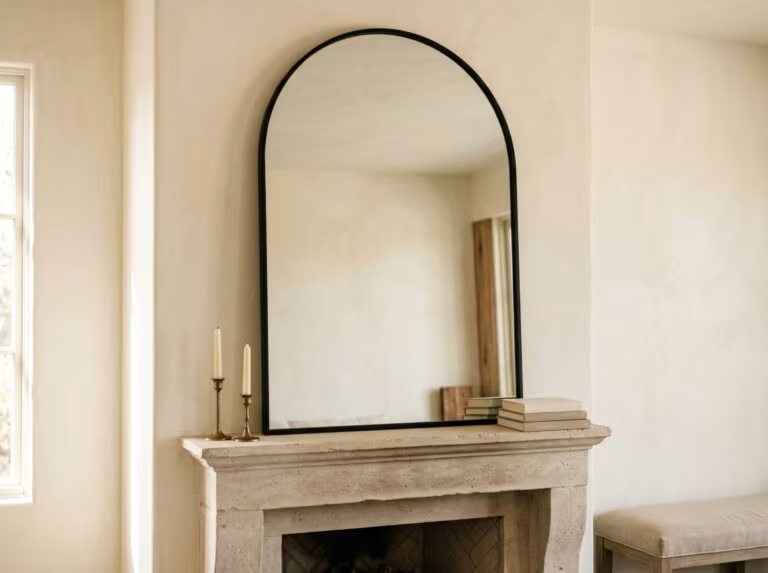
A mirror hung above a console or sofa should measure roughly two-thirds the width of the furniture beneath it — wide enough to feel proportionate, narrow enough to avoid overwhelming the piece it sits above. The Amber Lewis x Four Hands Patz Mantel Wall Mirror, at 40 inches wide and 33 inches tall with a slim aluminum frame and gently contoured silhouette, exemplifies this ratio beautifully over a standard sofa or console — substantial enough to anchor the wall, restrained enough not to compete with what’s below it. Priced at $799 through Lumens, it stands as sculpture in its own right, its soft curve softening what could otherwise be a hard rectangular void.
Pros
- A softened contour that breaks up hard rectangles (especially above consoles and sofas).
- Slim frame reads quiet and architectural rather than heavy or ornate.
- The size is substantial without dominating a wall.
Cons
- A statement mirror still needs breathing room—crowded walls can flatten the effect.
- If you want a bold, decorative frame, this one will feel intentionally restrained.
Who it’s for
- Living rooms and entries that need one calm anchor piece.
- Anyone trying to add light and softness without adding “decor noise.”
- Rooms where the wall above a console/sofa feels empty but art feels too static.
Who shouldn’t buy
- If your style depends on ornament, carving, or heavy vintage framing.
- If your space is very small and you need an ultra-narrow mirror to fit.
Placement guidance
- Over a console/sofa: aim for ~2/3 the furniture width (as you note).
- Keep 6–8 inches between the furniture top and the mirror’s bottom edge.
- For safety and a cleaner look: mount into studs when possible (or use proper anchors rated for the mirror’s weight).
Amber Lewis x Four Hands Patz Mantel Wall Mirror
by Four Hands
A wall-mounted 40″W x 33″H mirror with a slim aluminum frame and gently contoured silhouette.
Price at time of publishing· Subject to change
US only
Mounting Height for Comfortable Sightlines
The mirror’s center should sit roughly at eye level for the average adult — around 57 to 60 inches from the floor. Above a console or mantel, this typically means leaving 6 to 8 inches of clearance between the furniture top and the mirror’s lower edge.
Placement Guidance: The Mirror Moves That Change a Room
A mirror works hardest when it reflects something worth doubling—light, depth, an open doorway, a view.
- For brighter rooms: place the mirror opposite or perpendicular to a window to redirect daylight.
- For wider-looking rooms: use a mirror at the end of a hallway or on the long wall of a narrow room to stretch perspective.
- For calmer walls: keep the area around a mirror slightly edited—mirrors amplify visual noise as easily as they amplify light.
- For comfort: center height around 57–60 inches from the floor in most rooms, then adjust based on furniture height and sightlines.
- For safety: heavy mirrors deserve proper anchors (or studs). A beautiful mirror is not worth a wall repair—or worse.
Entryway Mirror Ideas That Welcome and Function
The entryway is often a mirror’s most-used post in the house — equal parts first impression and daily ritual.
Leaning vs. Wall-Mounted Silhouettes
A leaning mirror offers flexibility without commitment, easily repositioned or moved to a new home entirely — a strong option for a bench-adjacent vignette, whether paired with fixed shelving or a piece like Entryway Bench Ideas. A wall-mounted mirror, by contrast, feels more permanent and frees up floor space in tighter entries.
Round vs. Arch Shapes for Different Entry Styles
A round mirror softens an entry’s geometry and suits more traditional or transitional spaces, while an arched silhouette brings a slightly more sculptural, elongated presence — ideal for entries with higher ceilings that can support the extra height.
Pairing With Sconces for Warmth and Light
Flanking an entryway mirror with a pair of sconces adds both function and polish — light for a final outfit check, warmth for the first thing a guest sees upon arrival. This pairing is one of the most reliable styling formulas in the entryway, detailed further in Minimalist Wall Sconces.
Fireplace Mantel Mirror Ideas That Reflect Without Glare
A mantel mirror carries more visual weight than almost any other placement in the home, simply by virtue of the fireplace’s natural gravity.
Choosing a Shape Proportionate to the Hearth
A mantel mirror should echo the general proportions of the fireplace surround beneath it — a wide hearth calls for a wider mirror, while a narrower, taller mantel suits a more vertical silhouette.
Avoiding Glare From Firelight or Windows
Position the mirror to avoid reflecting a window directly across the room, which can create harsh glare at certain times of day. A slight offset in angle, even a few degrees, often solves this without sacrificing the light-bouncing benefit entirely.
Styling the Mantel Around the Mirror
Once the mirror is hung, style the mantel beneath it with the same height-and-texture logic used elsewhere in the room — a few varied-height objects, nothing crowding the mirror’s lower edge.
Bedroom Mirror Styling — Dresser vs. Leaning Floor Mirror
The bedroom asks a mirror to do double duty: functional getting-ready tool and softening design element.
Round Mirrors Over a Dresser for Everyday Routines
A round mirror above a dresser suits the quick, everyday rituals of a morning routine — accessible, unobtrusive, and gentle on a room’s overall geometry when paired with a rectangular dresser beneath it.
Leaning Floor Mirrors for Full-Length Function
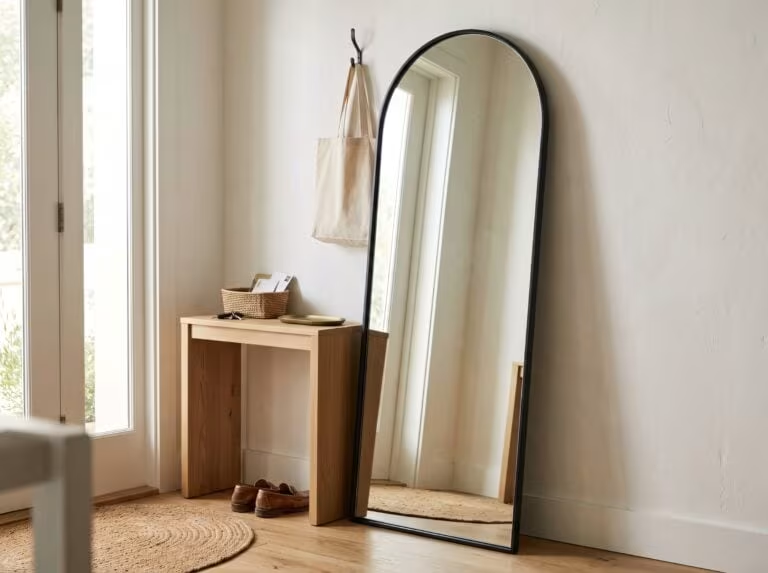
A full-length leaning mirror offers something a dresser mirror can’t: a complete view, ideal for getting dressed. The Ayra Full Length Mirror, with its softly arched top and slim iron frame at 28 inches wide and 74 inches tall, suits either leaning against a wall or mounting outright — flexible enough to adapt as a bedroom’s layout evolves. Priced between $342.30 and $396.90 through Lumens, depending on finish, it brings a quietly opulent softness to a piece that’s often purely utilitarian.
Pros
- Full-length function with a silhouette that still feels designed.
- Arched top softens bedrooms and entryways immediately.
- Flexible: leans or mounts depending on the room’s constraints.
Cons
- Leaning requires real wall space (and a little visual quiet around it).
- Full-length mirrors amplify what they reflect—clutter nearby will double itself.
Who it’s for
- Bedrooms where getting dressed is part ritual, part utility.
- Entries that need a last-look mirror without building a full console moment.
- Anyone who wants a mirror to feel like architecture, not an accessory.
Who shouldn’t buy
- If you don’t have clearance to step back and see a full reflection.
- If the mirror will sit in a high-traffic collision zone (tight hallways, behind doors).
Placement guidance
- If leaning: leave enough floor space to stand back 3–5 feet for a usable view.
- Avoid placing directly opposite a bright window in a bedroom—morning glare can be harsh.
- If wall-mounting, center the reflective area where you’ll actually stand (not just where it looks centered on the wall).
Ayra Full Length Mirror
by Huxe
Full-length mirror with a softly arched top and slim iron frame (28″ W x 74″ H) designed to lean or wall-mount.
Price at time of publishing· Subject to change
US only
Pros and Cons of Each Setup
A dresser mirror saves floor space but offers a limited view; a leaning floor mirror provides full-length function but requires several feet of wall space to lean against comfortably. Many bedrooms benefit from both, positioned in different corners of the room.
Bathroom Mirror Frames and Finishes That Hold Up to Humidity
Bathroom mirrors face a different set of demands entirely — durability against moisture matters as much as style.
Wood Frames and Moisture Considerations
Wood frames bring warmth to a bathroom but require a sealed or moisture-resistant finish to prevent warping over time in a consistently humid environment.
Metal Finishes for Durability
Metal frames — particularly brass, chrome, or matte black — hold up reliably to humidity and require little more than occasional wiping to stay looking sharp for years.
Frameless Mirrors for Low-Maintenance Simplicity
A frameless mirror sidesteps the moisture question entirely, offering the lowest-maintenance option for a bathroom while still delivering a clean, unfussy elegance.
Mirror Gallery Wall Ideas That Stay Cohesive
A gallery wall built from mirrors instead of art brings the same layered visual interest, with the added benefit of amplified light throughout the grouping.
Mixing Shapes Without Visual Chaos
The key to a cohesive mirror gallery wall lies in variety without disorder — different shapes and sizes, but grouped closely enough that the collection feels like one considered installation rather than a scattered assortment.
Balancing Metallics and Vintage Finds
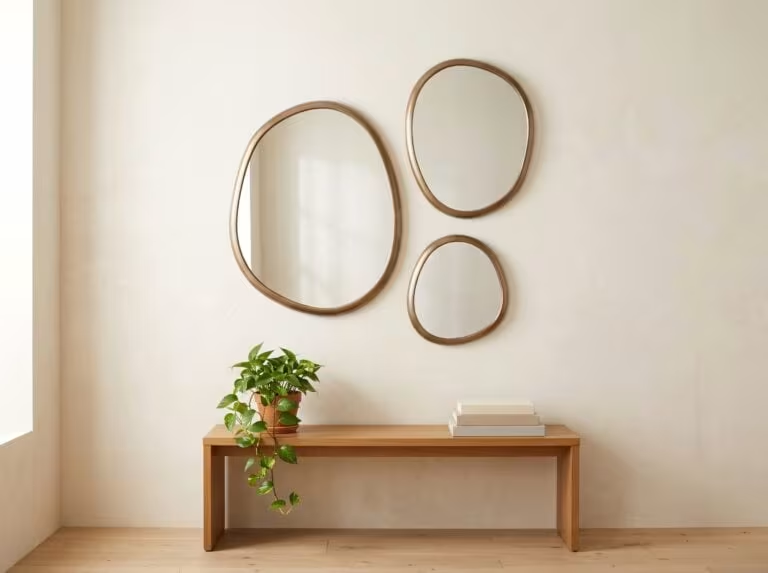
A shared metallic finish across an otherwise varied collection of shapes ties a gallery wall together instantly. The Organic Pebble Mirrors Set of 3, each an irregular pebble-shaped silhouette in a soft brushed bronze finish, illustrates this principle precisely — three distinct shapes, one unifying tone, designed from the outset to be grouped together. Priced at £349 through Heal’s, the set removes the guesswork of matching finishes across separately sourced vintage pieces.
Pros
- Cohesion without sameness: varied shapes, one finish.
- Reads collected and sculptural even in small groupings.
- Easier than piecing together a mixed set and hoping the finishes agree.
Cons
- Small mirrors don’t “brighten a room” the way one large mirror can; they’re more about texture and glints of light.
- Requires thoughtful spacing—too scattered and the wall looks nervous.
Who it’s for
- Anyone wanting a mirror moment that feels like art, not utility.
- Hallways, stair landings, and small walls that need interest without bulk.
- Homes already working with warm metals (aged brass/bronze tones).
Who shouldn’t buy
- If you need one mirror for daily function (choose a larger single mirror instead).
- If your style leans very sharp, graphic, and symmetrical—pebble shapes are intentionally organic.
Placement guidance
- Treat them like a cluster, not three separate objects: keep them visually connected.
- Start with one “lead” mirror at eye level, then build outward.
- Lay out the arrangement on the floor first; then transfer measurements to the wall.
Organic Pebble Mirrors Set of 3
by Heal’s
Set of three metal‑framed, irregular pebble‑shaped mirrors in a soft brushed bronze finish intended to be grouped together.
Price at time of publishing· Subject to change
EU only
Layout Formulas for a Pin-Worthy Wall
Lay the full arrangement out on the floor before committing to nails, adjusting spacing until the shapes feel balanced rather than symmetrical. A slightly asymmetrical, organic cluster — like the Pebble Mirror set naturally invites — tends to photograph better than a rigid grid.
FAQs
Where should I put a mirror to make a room brighter?
Opposite a window is the strongest light-bounce placement. If that causes glare, place it perpendicular to the window instead—still brightening the room without reflecting the glass straight back.
What should a mirror reflect?
Something you’d like to see twice: a window, a doorway, a piece of art, greenery, or a well-lit vignette. Avoid placing a mirror where it mostly reflects clutter, cords, or an empty wall.
How high should I hang a mirror?
A reliable baseline is to place the mirror’s center at 57–60 inches from the floor. Over furniture, keep 6–8 inches between the furniture top and the mirror’s bottom edge.
How big should a mirror be over a console or sofa?
Roughly two-thirds the width of the furniture beneath it is the proportion that most often looks intentional.
Is a leaning mirror better than a wall-mounted mirror?
Leaning mirrors feel relaxed and flexible (great for renters). Wall-mounted mirrors feel more permanent and save floor space in tighter entries and bedrooms.
How do I avoid glare from a mirror?
Avoid placing it directly opposite a bright window if glare is an issue. A slight shift in placement—or angling the mirror a few degrees—often solves it while keeping most of the light benefit.
Are mirror gallery walls worth it?
Yes when you want texture and shimmer more than pure brightness. A large single mirror is better for major light expansion; a mirror gallery is better for layered, sculptural interest.
There’s a particular kind of room that only a mirror can create — one that feels larger, brighter, and more finished simply because of where the light now travels. The hallway stretches further than it should. The entryway glows a little warmer at dusk. The bedroom, dressed and ready, holds a full reflection rather than a guess.
A mirror asks so little and returns so much. Explore the pieces we return to again and again, and let a little more light find its way home.
About the author
Mabrouk Mhamdi is the curator behind Apex Illume, an independent editorial guide to refined minimalist interiors—focused on lighting, seating, and décor chosen for proportion, materiality, and long-view design. Recommendations are research-based and selected to reduce decision fatigue with a tighter, more considered edit.