
Living Room Accent Chair Ideas: How to Choose and Place a Statement Seat
By Mabrouk Mhamdi · Curator at Apex Illume
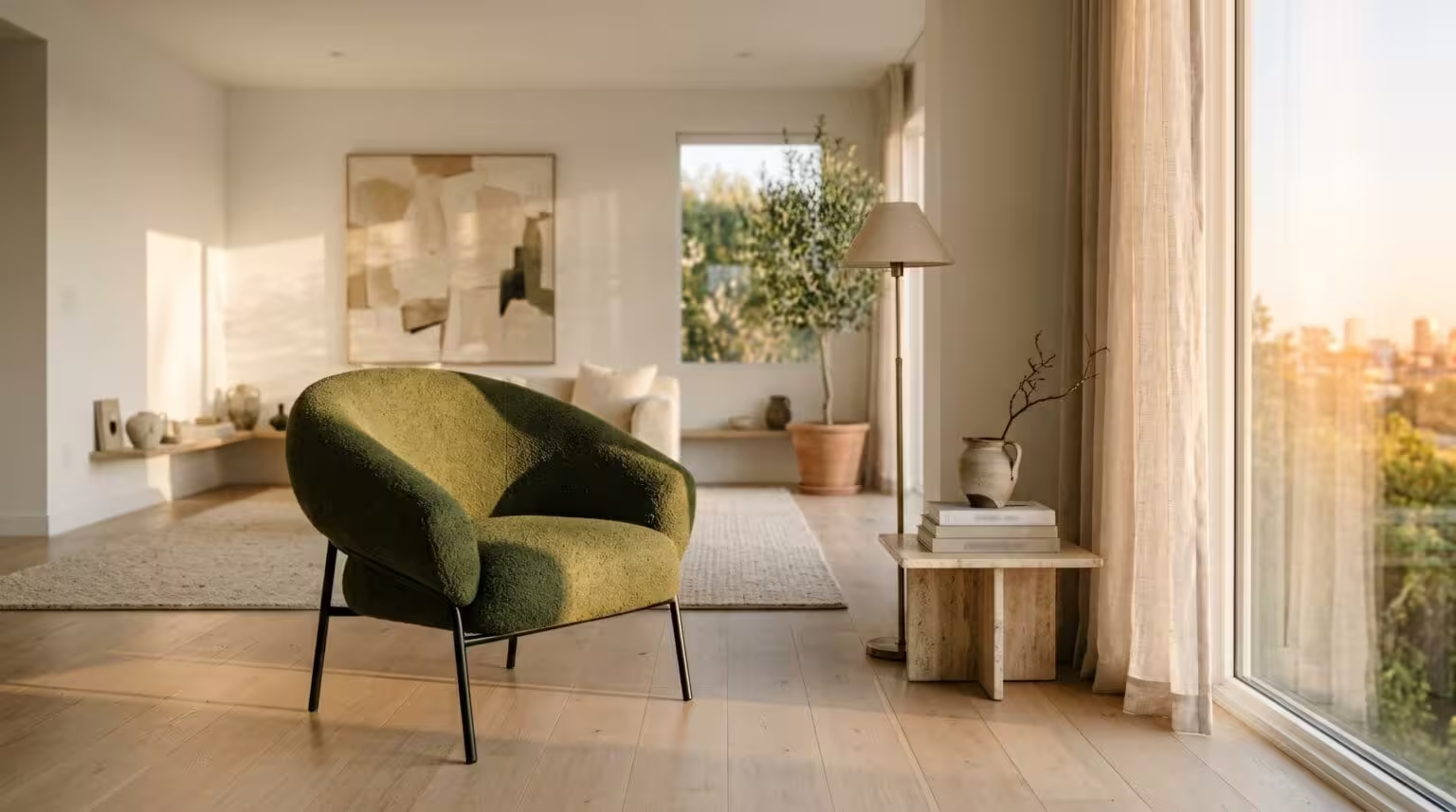
There is a particular kind of morning light that finds its way into a living room and settles, uninvited, into the folds of a single chair. It catches the curve of a bouclé back, pools along a tubular steel leg, and for a moment, the whole room seems to organize itself around that one piece of furniture.
This is the quiet power of a statement seat. Not a filler piece. Not an afterthought pulled from a clearance aisle. A chair that holds its own gravity — sculptural enough to catch the eye, tactile enough to invite the hand, grounded enough to feel like it was always meant to live exactly there.
Choosing one is less about furniture shopping and more about editing a feeling into place. What follows is everything that separates a chair that merely fits from one that finishes the room.
“Apex Illume is reader-supported. When you purchase through links on our site, we may earn an affiliate commission at no extra cost to you.”
How We Chose Statement Seats That Finish a Room
A statement chair succeeds when it’s doing two things at once: holding visual gravity and offering real comfort. For this guide, I focused on proportion (seat height harmony with sofas, width that reads substantial without becoming a second sofa), materials that live well (performance fabrics, leather, tactile bouclé used intentionally), and placement logic—because even the most sculptural chair fails if it interrupts the room’s rhythm.
Finding the Right Scale — Size Cues That Make a Chair Feel Considered
Scale is the difference between a chair that feels inevitable and one that feels apologetic. Get it right, and the eye never questions it. Get it wrong, and no fabric or finish will save it.
Seat Height and Sofa Harmony
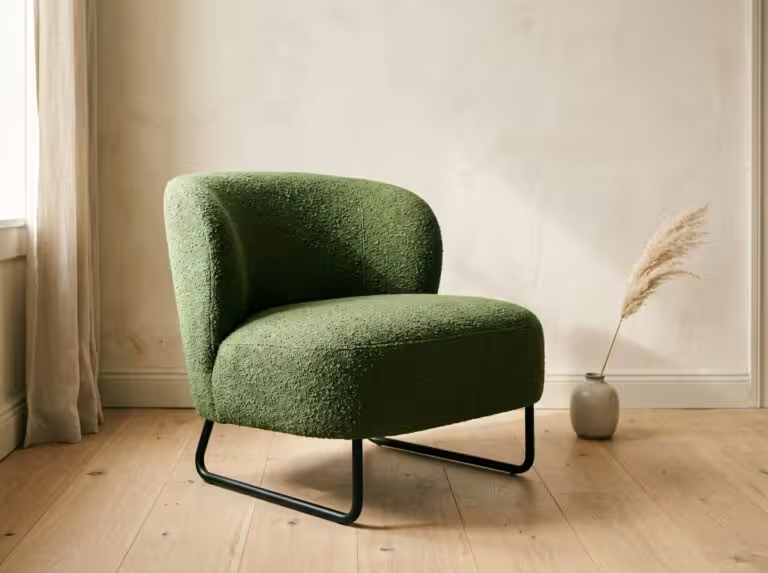
Accent chairs flatter a room most when they sit within an inch or two of the sofa’s seat height — typically 17 to 19 inches from the floor. A low-slung silhouette like the Ella Lounge Chair with Tubular Legs, at 27.4 inches overall height, feels grounded rather than perched, settling into a sofa’s sightline instead of interrupting it. A side table topped with a soft glow — the kind cast by Travertine Table Lamps — can help bridge that height visually, tying the chair’s silhouette to the rest of the seating arrangement.
Pros
- Sculptural curve that reads intentional from across the room.
- Bouclé texture adds depth without pattern noise.
- Tubular base keeps it visually light while still grounded.
Cons
- Best in lower-traffic zones; bouclé prefers calmer living.
- A statement chair asks for restraint around it—too many “loud” pieces and the room loses clarity.
Who it’s for
- Rooms that need one tactile focal note.
- Anyone who wants the chair to feel like sculpture, not just additional seating.
Who shouldn’t buy
- If this will be the household’s most-used, most-abused seat.
- If you prefer a chair that disappears completely into the background.
Placement guidance
- Give it space beside it—don’t wedge it into a corner unless the corner is intentionally styled.
- Pair with warm, low lighting so the texture reads soft at night, not flat.
Ella Lounge Chair with Tubular Legs
by Case Furniture
steel base – Moss Bouclé
Price at time of publishing· Subject to change
Price at time of publishing· Subject to change
Proportion Rules for Width, Depth, and Arm Height
A chair’s width and depth should feel proportionate to the body sitting in it, not to the empty square footage around it. A generous 30- to 34-inch width feels substantial without becoming a second sofa. Arm height matters more than most realize — arms that hit just below elbow level feel supportive; arms that rise too high make the whole piece feel boxy and stiff. The goal is a frame that looks as though it was drawn specifically for the room, not selected from a catalog of approximations.
Where the Chair Belongs — Placement That Invites Conversation
A beautiful chair in the wrong spot becomes a beautiful obstacle. Placement is where design intention either holds or collapses.
Angled Toward the Sofa
Angling a chair slightly toward the sofa, rather than facing it head-on, creates the most natural conversational geometry. This soft diagonal invites conversation without demanding it — a posture, not a confrontation.
Anchoring a Window, Fireplace, or Reading Nook
Some chairs aren’t meant to converse at all. They’re meant to anchor a quieter corner — beside a window where the light pools in the afternoon, or near a fireplace where warmth and stillness intersect. In these settings, Ambient Corner Lighting does quiet work, softening the edges of the nook after the sun retreats and giving the chair a reason to be occupied well into evening.
Keeping Traffic Paths Clear
No chair, however sculptural, earns its place if it interrupts the room’s natural rhythm. Leave at least 30 inches of clearance for walking paths. A chair that requires visitors to navigate around it like an obstacle course was placed in haste, not with intention.
Placement Guidance: One Chair, Two Chairs, or a Corner Nook
- One chair: angle it toward the sofa for conversation without confrontation.
- Two chairs: mirror them for symmetry, or offset them with an ottoman to soften the room.
- Corner nook: add a small table and a warm lamp—otherwise it reads like unused furniture, not a destination.
Matching, Mixing, or Contrasting With Your Sofa
The question isn’t whether to match — it’s whether matching serves the room’s larger story.
When Symmetry Wins
In rooms with formal proportions — high ceilings, symmetrical windows, a fireplace as centerpiece — matching upholstery between chair and sofa creates a calm, cohesive backdrop. This works especially well when the room already carries visual complexity elsewhere: layered textiles, a bold rug, an active gallery wall.
When Contrast Adds Character
In more relaxed or eclectic spaces, contrast becomes the more interesting choice. A sofa in soft linen paired with a chair in rich, saturated bouclé feels intentional rather than chaotic — as long as the two pieces share a common thread, whether that’s a wood tone, a metal finish, or a shared undertone in color palette.
Choosing an Upholstery That Lives as Beautifully as It Looks
Fabric is where aspiration meets daily life. Even the most beautiful chair in the room still has to survive it.
Performance Velvet for Depth and Durability
Performance velvet delivers the visual richness of traditional velvet — deep color saturation, a soft sheen that shifts with the light — without sacrificing durability. Treated fibers resist staining and crushing, making it a rare fabric that photographs beautifully and holds up to actual living.
Leather for Patina and Ease
Leather ages instead of wearing out. Each year adds character rather than damage, and the material only asks for the occasional wipe-down in return. It suits rooms that want warmth with minimal upkeep — a chair that becomes more interesting, not more tired, with time.
Bouclé for Texture-Forward Softness
Bouclé brings a tactile softness that feels hushed and opulent rather than fussy. Its nubby texture hides minor wear beautifully, though it’s better suited to lower-traffic corners than to a chair fielding daily use from kids or pets. The Ella Lounge Chair with Tubular Legs, upholstered in Moss Bouclé over a curved, low-slung frame with a tubular steel base, is a study in this restraint — 30.6 inches wide, 28.7 deep, and priced at $1,385 through 2Modern. It’s the kind of chair that photographs like sculpture and feels like a favor to whoever sits in it.
Small-Space Accent Chair Ideas That Preserve Flow
A small room doesn’t have to forgo a statement — it simply requires a lighter hand.
Leggy Frames and Slim Silhouettes
Chairs with exposed wood or metal legs let light pass beneath them, visually expanding the floor space. Paired with slim, tapered arms, these frames deliver presence without density — the visual equivalent of a room that can still breathe.
Compact Swivels as Space-Savers
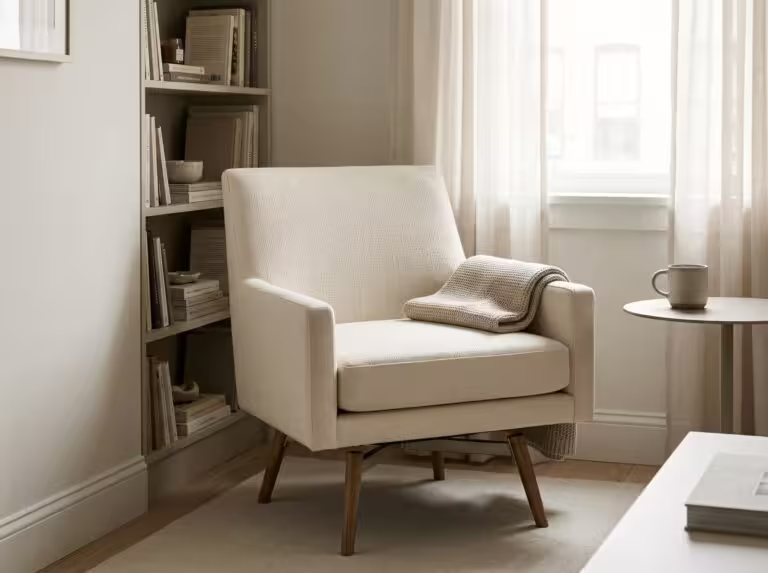
A compact swivel chair solves a problem most small rooms face: not enough distinct zones. The Banks Swivel Chair answers this directly — just 27 inches wide, with slim arms and a full 360° swivel base, available in performance fabric neutrals like Cambric Ivory and Alcala Taupe, or in top-grain leather. Priced from $719.20 through 2Modern, it rotates toward the window by day and the fireplace by night, doing the work of two chairs without asking for two chairs’ worth of space.
Pros
- Compact footprint with real functional flexibility.
- Swivel makes small rooms feel more usable.
- Performance fabric/leather options support different lifestyles.
Cons
- Swivels need clearance; too tight and the feature becomes frustrating.
- Compact size may feel less lounge-friendly for taller frames.
Who it’s for
- Small living rooms with multiple focal points.
- Anyone who wants one chair to serve reading, conversation, and view.
Who shouldn’t buy
- If you want a wide, sink-in seat for long lounging.
- If the chair must live in a tight spot where it can’t rotate.
Placement guidance
- Place it where turning makes sense—between sofa and window, or near the fireplace edge.
- Add a small side table so the chair feels like a real destination, not a spare seat.
Banks Swivel Chair
by Four Hands
offered in performance fabric neutrals Cambric Ivory (90% polyester/10% flax) and Alcala Taupe (70% polyester/20% viscose/10% flax), plus top-grain leather option.
Price at time of publishing· Subject to change
US only
Pairing Two Accent Chairs With a Sofa or Sectional
Two chairs, arranged with purpose, can do more for a room’s balance than any single piece.
Mirrored Pairs Opposite the Sofa
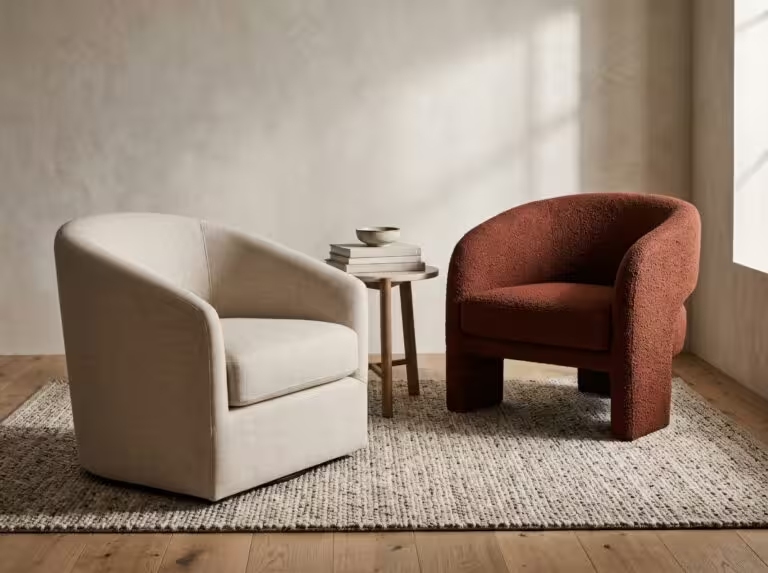
Identical chairs placed opposite the sofa create instant symmetry — the classic, editorial living room arrangement. A pair of the Inaya Modern Accent Chair, with its simple rounded tub silhouette and linen upholstery in Ivory, Cream, or Grey, suits this arrangement particularly well; its understated shape lets it repeat across a room without ever feeling redundant. Priced between $580.14 and $638.19 through Lumens, it’s a quietly opulent way to fill two spots with one confident decision.
Pros
- Understated silhouette that repeats well in pairs.
- A calm foundation for many room styles.
- Works when you want balance, not drama.
Cons
- If your room needs a strong focal note, this chair won’t be it—it’s intentionally restrained.
- Linen-like upholstery can require more care than performance textiles.
Who it’s for
- People building a symmetrical, editorial living room layout.
- Rooms that already have texture/pattern elsewhere and need seating to settle the scene.
Who shouldn’t buy
- If you want the chair to be the boldest object in the room.
- If you need the most spill-proof, kid-proof solution.
Placement guidance
- Best in pairs opposite a sofa or flanking a focal point.
- Keep proportions cohesive—match chair height/visual weight to the sofa so it reads intentional.
Inaya Modern Accent Chair
by Alder & Ore
linen upholstery available in neutral tones (Ivory, Cream, Grey)
Price at time of publishing· Subject to change
US only
Offset Arrangements With a Shared Ottoman
For a softer, more lived-in feel, offset the two chairs at gentle angles and unite them with a single shared ottoman. This arrangement invites movement and flexibility — ideal for rooms that shift between quiet reading and full conversation.
Keeping Heights and Lines Cohesive
Whichever arrangement you choose, keep seat heights and arm lines consistent between the two chairs. Visual rhyme matters more than identical fabric — a pair of chairs in complementary tones but matching proportions will always feel purposeful together, especially when styled beneath a gallery wall arrangement, like the layouts explored in Gallery Wall Ideas (coming soon to the Decor journal).
Swivel or Stationary — Choosing for a Multi-Focal Room
Not every room asks its seating to stay still.
When a Swivel Earns Its Footprint
Rooms with more than one focal point — a fireplace on one wall, a television on another, a window view begging for attention — benefit enormously from a swivel base. A chair like the Banks Swivel Chair becomes an adaptable vantage point rather than a fixed commitment, turning toward whatever the room asks of it that hour.
When a Fixed Frame Feels More Grounded
In rooms built around a single, clear focal point, a stationary frame feels more settled — less like a solution to indecision and more like a deliberate anchor. The Inaya Modern Accent Chair, with its fixed tub-shaped base, suits this kind of room: a reading corner, a fireside seat, a spot that doesn’t need to look anywhere but where it already faces.
Color and Pattern — Making the Chair a Focal Point Without Clashing
Color is where the chair either sings or shouts. The difference lies in restraint.
Tonal Layering vs. Deliberate Contrast
A chair in a tone closely related to the room’s existing palette adds richness without visual noise — this is tonal layering at its most sophisticated. A moss-toned bouclé chair against warm neutrals, for instance, deepens a room rather than interrupting it. A chair in bold, deliberate contrast, on the other hand, becomes the room’s focal note. Both strategies work; the failure mode is landing accidentally in between.
Applying the 60-30-10 Rule
A dependable framework: 60 percent dominant color (walls, large upholstery), 30 percent secondary color (rugs, drapery), and 10 percent accent — often the chair itself. This ratio keeps a bold chair from overwhelming the room while still letting it command attention.
Pulling Hues From Rug, Art, or Drapery
Effortless color choices are rarely invented from scratch. Pull a hue directly from an existing rug, a piece of art, or a drapery panel, and the chair will feel like it was born from the room rather than introduced to it.
FAQs: Living Room Accent Chairs
How do I choose the right size accent chair?
Look for seat height harmony first (typically 17–19 inches). Then choose width by intent: 30–34 inches feels substantial without becoming sofa-like.
How far should an accent chair be from the sofa?
Far enough for movement, close enough for conversation—often 18–30 inches, depending on table placement and room size.
Should accent chairs match the sofa?
Not necessarily. The goal is a shared thread (tone, finish, or proportion). Contrast often looks more collected than perfect matching.
Is a swivel chair worth it?
In multi-focal rooms, yes. It keeps one chair useful across different moments without forcing a layout change.
What’s the most durable upholstery for an accent chair?
Leather and performance fabrics tend to be the most forgiving. Bouclé is beautiful for calmer corners.
How do I arrange two accent chairs in a small living room?
Use slim silhouettes, keep arms/heights cohesive, and preserve 30 inches of walkway clearance so the room still breathes.
There’s a particular satisfaction in walking into a living room and feeling, before you can articulate why, that everything belongs. The rug sets the tone. The light does its slow work in the corners. And the chair — sculptural, tactile, exactly the right height and hue — holds the room together like a closing thought.
A single seat, chosen with this much intention, rarely reads as furniture. It reads as instinct. Explore the pieces we return to again and again, and let one chair do the work of finishing a room.
About the author
Mabrouk Mhamdi is the curator behind Apex Illume, an independent editorial guide to refined minimalist interiors—focused on lighting, seating, and décor chosen for proportion, materiality, and long-view design. Recommendations are research-based and selected to reduce decision fatigue with a tighter, more considered edit.