
The Six Pillars of a Luxury Lighting Collection: How to Layer Ambient, Task & Accent Like an Architect
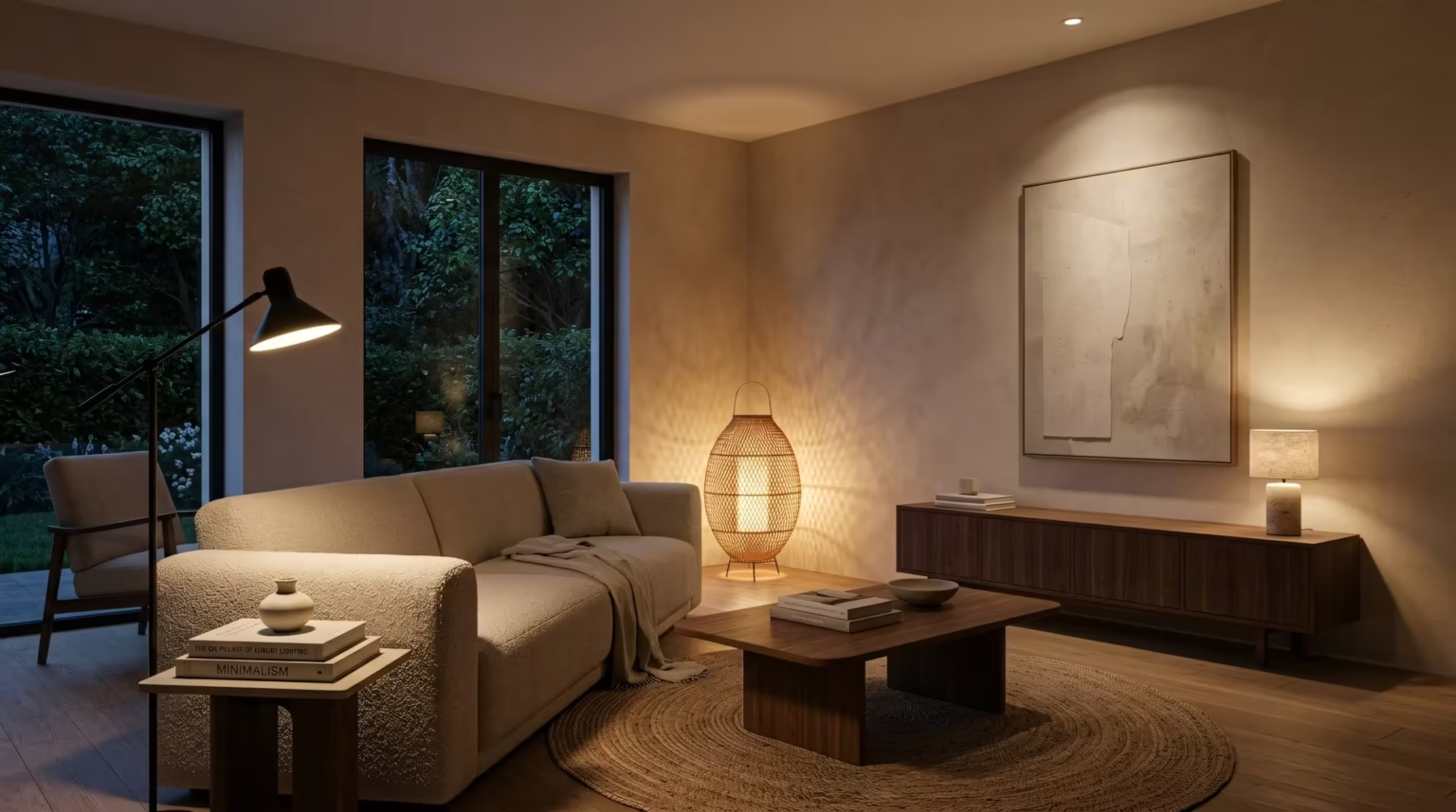
A room does not read as costly because a fixture carries a high price tag. It reads as costly because the light has been composed — soft foundations, precise work light, and a handful of controlled highlights that draw the eye exactly where it should go.
“Apex Illume is reader-supported. When you purchase through links on our site, we may earn an affiliate commission at no extra cost to you.”
The Architectural Premise: Light as Composition
Interior luxury has quietly shifted its vocabulary. It is no longer measured in wattage or in the number of fixtures a room can hold — it is measured in restraint, in glow, and in the degree of control a homeowner has over how a space feels after dark. A living room lit by a single overhead source will always look flat, regardless of what sits beneath it. A living room built from three or four considered sources — each doing a distinct job — will look designed, even furnished with modest pieces.
This is the architect’s method, and it rests on three functional layers.
The Three Layers, Defined
Ambient (the foundation).
This is the room’s atmosphere — the layer that softens contrast, removes the fatigue of a single bright point, and sets the overall mood before any other decision is made. Ambient light should be felt more than noticed.
Task (the precision).
This is light placed exactly where the eye is asked to work: a desk, a reading chair, a kitchen island, a bedside book. Task light is judged on accuracy — does it land where it’s needed, without spilling glare into the rest of the room.
Accent (the curation).
This is the layer that adds depth and narrative — a raking light across stone veining, a woven shade throwing pattern onto a wall, a pool of light that draws the eye toward a piece of art rather than the ceiling. Accent light is where a room stops looking furnished and starts looking curated.
A well-composed room uses all three in conversation, never one at the expense of the others.
Quick Start: Choose Your Layer
- If the room feels flat: start with Ambient (corner glow and diffusion first).
- If you read/work at night: start with Task (beam control, glare discipline).
- If the room lacks depth: add Accent (texture, grazing, and a deliberate highlight).
- If you want one hero move: choose a bridge fixture that can behave as both ambient and task.
Six Fixtures, One Architecture of Light
This guide is built around six hero pieces, each assigned a specific role in the layering system:
- Ambient cornerstone: the Bolla Floor Lamp XL in rattan, casting a diffuse lantern glow through its weave.
- Sculptural bridge between ambient and task: the Arco LED Floor Lamp, which spans light over a seating or dining moment without a ceiling junction.
- Task authority: the Tizio Classic Table Lamp, a balanced armature built for precise aim.
- Minimal wall task with soft accent capacity: the Real Simple Wall Lamp, a swing-arm fixture with hi-lo control.
- Linear ambient-task hybrid: the Dorian Linear LED Pendant, with rotatable light tubes and integrated high-CRI output.
- Stone accent with cordless flexibility: the Kibun Fluted Column, in travertine, delivering warm, tunable output without a cord in sight.
Control Is the New Luxury
None of the above matters without control. A fixture’s Kelvin temperature, its CRI rating, and its dimming behavior determine whether a room feels composed or merely occupied. Dimming compatibility prevents flicker and dead-travel on integrated LED drivers. Kelvin consistency across an open plan prevents one corner from reading “warm hotel lobby” while another reads “surgical clinic.” CRI above 90 ensures that stone veining, textile weave, and skin tone render honestly rather than flatly. The specification of light — not the price of the fixture — is where luxury interiors are actually won.
Master Comparison Table
| Hero module | Layer role | Control priority | Best for | Tradeoff |
|---|---|---|---|---|
| Flos Arco LED Floor Lamp | Ambient–Task bridge + sculptural presence | Glare control + dimming behavior | Centering light over a sofa or table without ceiling wiring | Needs physical space and clear circulation around the base |
| Real Simple Wall Lamp (Robert Abbey) | Task-first, with soft ambient spill | Bulb spec (Kelvin/CRI) + shade diffusion | Bedside reading and precise wall-mounted function | Requires correct mounting height to avoid glare and awkward reach |
| Kibun Fluted Column (Bulbrite) | Accent + portable ambient | Warm Kelvin + low-level dimming | Stone-focused vignettes, cordless flexibility | More atmosphere than brightness; use as highlight, not main light |
| Dorian Linear LED Pendant (ET2) | Task-forward with ambient option | Dimming compatibility + glare management | Islands and long surfaces that need even, controlled light | Scale must be correct—too short looks under-specified |
| Tizio Classic Table Lamp | Pure task instrument | Aim + reflection control (monitor glare) | Focused desk work; adjustable precision | Not designed to be ambient—its restraint is the point |
| Bolla Floor Lamp XL (Gervasoni) | Ambient foundation + texture accent | Warm bulb spec + diffusion | Dead corners; rooms that need glow and shadow softness | Large scale; needs breathing room and ceiling height planning |
Editorial note on integrated LED versus bulb-dependent specification: Fixtures with integrated LED engines — Arco, Dorian, and the LED configuration of Tizio — arrive with Kelvin and CRI fixed at the factory. This guarantees consistency but removes flexibility later. Bulb-dependent fixtures — Real Simple, Bolla, and standard Tizio — put that decision in the designer’s hands, which matters when a piece must be tuned to sit alongside a specific stone, a specific textile, or an evolving art collection. Neither approach is superior; the correct choice depends on whether the room is finished or still being composed.
The Six Hero Product Modules
1. Flos Arco LED Floor Lamp — Sculptural Floor
Design Thesis
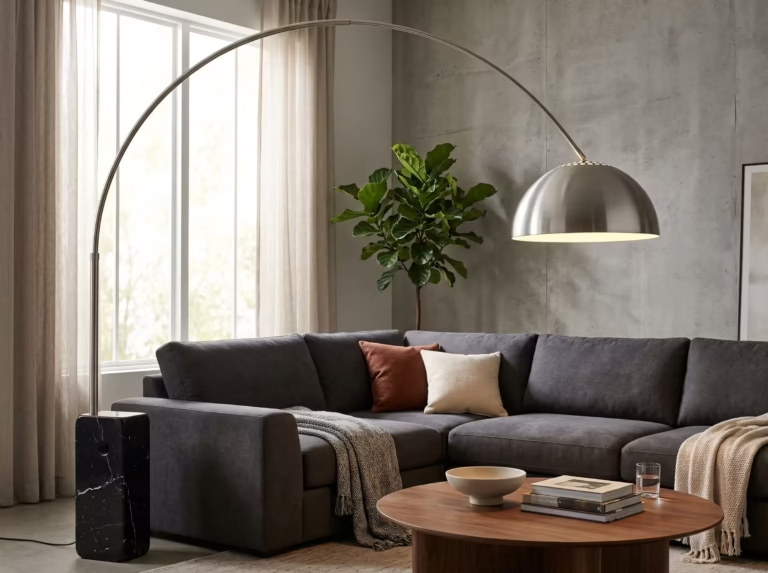
Few objects in modern lighting carry as much architectural authority as the Arco. Conceived by Achille Castiglioni to replace the pendant without the compromise of ceiling wiring, its marble base and telescopic aluminum arm allow light to hover over a room’s central gesture — a sofa, a dining table, a reading chair — with the visual weight of sculpture rather than furniture. It performs the rare trick of being both a statement and a solution.
Layer Role
Primary: Ambient-Task bridge. Secondary: Sculptural accent when unlit, given the density and polish of its marble counterweight.
Technical Spec Snapshot
- Materials: Carrara marble base, stainless steel telescopic stem, pressed and polished aluminum reflector
- Light source: Integrated LED, dimmable via 48V electronic interface
- Color temperature / CRI: 2700K, 93 CRI
- Output: 1224 lumens (manufacturer-published system flux)
- Dimming: Integrated electronic dimmer, smooth low-end performance
Placement & Proportion Rules
- Position the marble base so the arm’s reach centers directly over the seating or dining zone — not the room’s geometric middle.
- Allow at least 24 inches of clearance from the base to the nearest furniture edge to avoid a cramped, tripping-hazard silhouette.
- The reflector should sit low enough to feel intimate over a coffee table, but never below eye level when seated, to avoid direct glare.
Material Pairing Notes
Marble base pairs naturally with honed stone consoles, blackened steel hardware, and bouclé or linen upholstery. Avoid placing it near heavily veined countertops of a competing stone — let the Arco’s marble be the singular stone statement in its sightline.
If you’re designing a room around one unforgettable silhouette, our dedicated guide to sculptural floor lamps covers how to balance an icon piece like this against quieter, supporting layers.
Arco LED Floor Lamp
by Achille Castiglioni for FLOS
Brushed Polished Steel – Nero Marquina Marble
Price at time of publishing· Subject to change
Price at time of publishing· Subject to change
2. Real Simple Wall Lamp by Robert Abbey — Minimalist Wall
Design Thesis
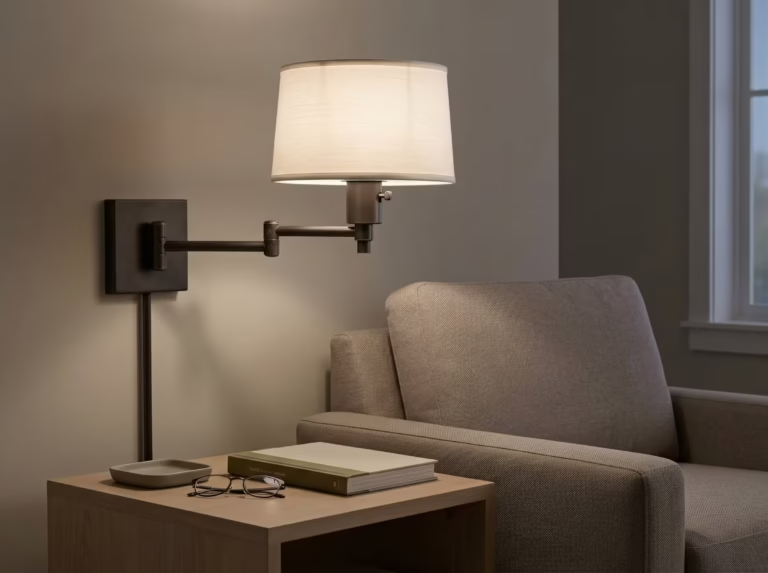
The Real Simple earns its name by refusing embellishment. A swing-arm silhouette in powder-coated steel, softened by a parchment shade and bottom diffuser, it exists to solve the most common lighting failure in bedrooms and libraries: a bedside lamp that either glares directly into the eye or fails to throw enough light to read by. Its architecture is quiet enough to disappear into a wall, yet its swing-arm reach gives it genuine task authority.
Layer Role
Primary: Task (reading, bedside, desk-adjacent). Secondary: Ambient spill through the parchment shade when dimmed low.
Technical Spec Snapshot
- Materials: Steel construction, powder-coat finish, parchment shade with bottom diffuser
- Light source: Replaceable, 1 × 60W max, Bulb Type A
- Color temperature / CRI: Bulb-dependent — specify a house standard, typically 2700K, 90+ CRI
- Dimming: Hi-Lo dimming built into the socket
- Mounting: Convertible cord-cover or direct-wire installation
Placement & Proportion Rules
- Mount so the swing arm’s fully extended reach lands 12–15 inches above the mattress line or desk surface for reading without shadow.
- Center the backplate at 48–52 inches from finished floor for bedside use; adjust downward for a lower headboard.
- Always specify the diffuser-equipped version near a headboard — an undiffused shade at close range produces visible filament glare.
Material Pairing Notes
The steel arm reads well against plaster walls, linen headboards, and brushed brass hardware. In a library setting, pair with walnut shelving and leather-bound spines — the parchment shade’s warmth echoes both materials without competing.
For a full specification playbook on mounting heights, swing-arm reach, and bedside symmetry, continue to our guide on minimalist wall lights and swing-arm sconces.
Real Simple Swingarm Wall Sconce
by Robert Abbey
Metal – Fabric and Paper
Price at time of publishing· Subject to change
US only
3. Kibun Fluted Column Table Lamp by Bulbrite — Travertine / Natural Stone
Design Thesis
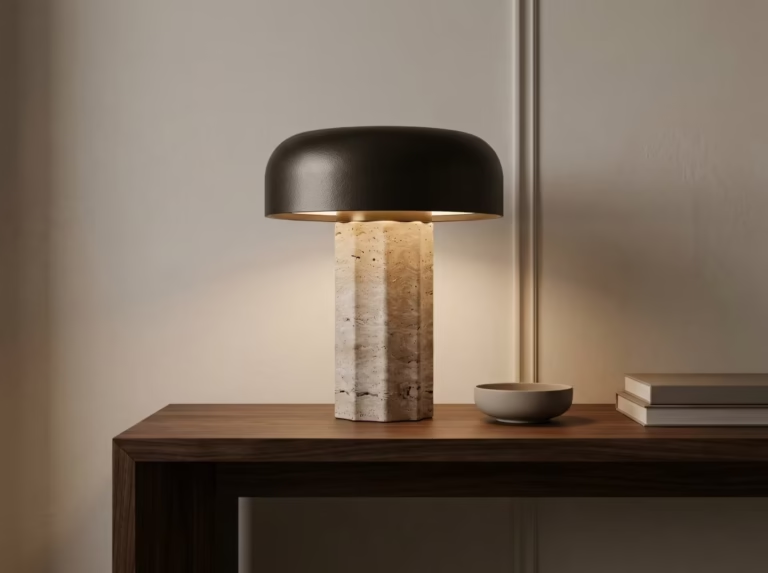
The Kibun behaves less like a lamp and more like a piece of jewelry set on a console. Its fluted travertine column catches ambient daylight during the day and, once switched on, returns a warm, stone-filtered glow after dark. Because it is fully cordless, it can be placed anywhere composition demands — a floating shelf, a bar cart, the center of a dining table — without the visual interruption of a cord trailing to an outlet.
Layer Role
Primary: Accent (stone-focused, sculptural). Secondary: Portable ambient light for small vignettes.
Technical Spec Snapshot
- Materials: Travertine body, bronze detailing; cordless, USB-C rechargeable
- Light source: Integrated LED
- Color temperature / CRI: 2700K, 92 CRI
- Output: Three brightness levels — 60 / 150 / 300 lumens
- Rating: IP20, damp-rated for bathroom vignettes
- Dimming: Built-in three-stage touch control
Placement & Proportion Rules
- Keep the fluted column’s height proportionate to its surface — on a narrow console, a single 15-inch unit is sufficient; on a long console, pair two for symmetry rather than sizing up.
- Because it is cordless, resist the temptation to center it — off-center placement beside a stack of books or a small object reads more considered.
- Use the lowest of the three output levels for ambient corner use; reserve the highest for genuine task moments, such as a powder room mirror.
Material Pairing Notes
Travertine harmonizes with honed limestone, aged brass, and boucle or raw linen textiles. It also holds its own beside darker walnut or ebonized oak, where the stone’s warmth provides necessary contrast. Avoid pairing with high-gloss lacquered surfaces, which compete with the stone’s matte, honed finish.
To build a cohesive stone story across the home — travertine, alabaster, marble, limewash — see our dedicated guide to natural stone and travertine lighting.
Kibun Fluted Column 15 Inch Table Lamp
by Bulbrite
Travertine – Chocolate Bronze
Price at time of publishing· Subject to change
US only
4. Dorian Linear LED Pendant by ET2 Lighting — Linear Suspension
Design Thesis
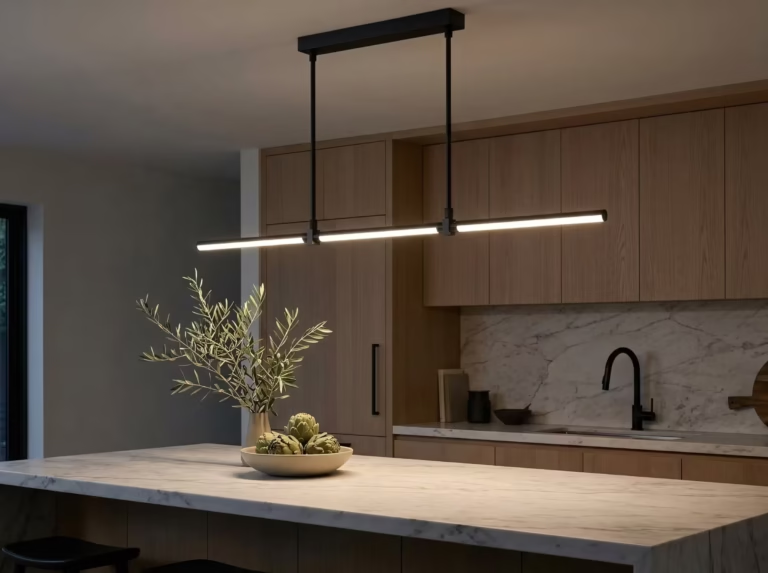
The Dorian addresses a specific architectural need: even, glare-controlled light across a long horizontal surface without the visual clutter of multiple pendants. Its rotatable tubes allow the beam to be angled toward the surface below or bounced upward for a softer wash, giving a single fixture the flexibility to shift between task-forward and ambient modes depending on the hour.
Layer Role
Primary: Task (island, dining surface). Secondary: Ambient wash when tubes are rotated upward.
Technical Spec Snapshot
- Materials: Aluminum, acrylic diffusion, steel suspension cable
- Light source: Integrated LED
- Color temperature / CRI: 3000K, 90 CRI
- Output: 860 delivered lumens (size and finish dependent)
- Dimming: Triac (CL) compatible
Placement & Proportion Rules
- The pendant’s total length should span roughly two-thirds the length of the island or table beneath it — not edge to edge.
- Hang so the fixture’s underside sits 30–34 inches above a dining table surface, or 34–38 inches above a kitchen island counter.
- Rotate tubes slightly downward over a dining table to control glare at eye level when seated; rotate upward in a corridor application for a softer, bounced ambient effect.
Material Pairing Notes
The aluminum and steel construction reads cleanest against quartzite or honed marble countertops, matte black hardware, and oak or ash cabinetry. It is one of the few fixtures on this list built to disappear into an architectural ceiling line rather than compete with it.
For island math — length versus island size, hanging heights, and glare control — jump to our guide on linear pendants and suspension systems.
Dorian Linear LED Pendant
by ET2 Lighting
Aluminum – acrylic diffusion – steel suspension cable
Price at time of publishing· Subject to change
US only
5. Tizio Classic Table Lamp — Architectural Task
Design Thesis
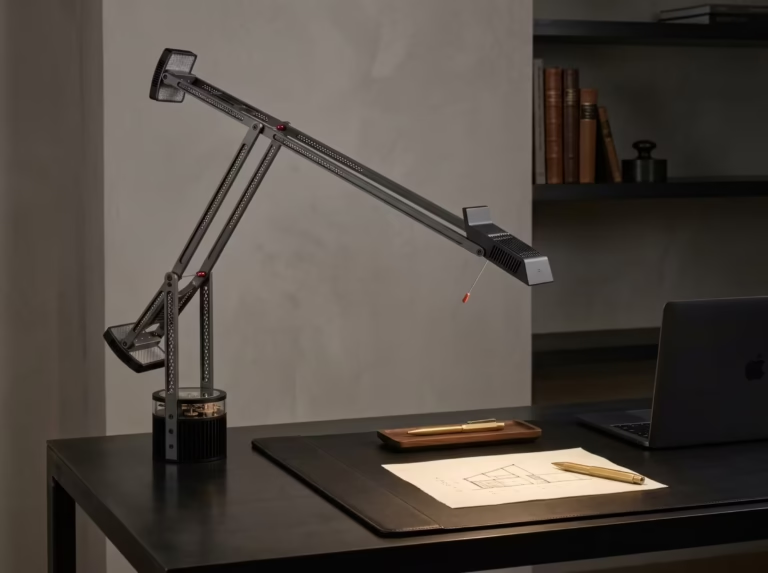
Designed as a counterbalanced instrument rather than a decorative object, the Tizio remains the reference point for architectural task lighting. Its aluminum and technopolymer armature moves on a spring-tensioned balance system that lets the head be aimed with a fingertip and holds position without a locking mechanism. It is a lamp built for people who work at a desk after dark and refuse to accept a fixture that dictates where they can sit.
Layer Role
Primary: Task (pure, directional). Secondary: None — Tizio is intentionally a single-purpose instrument, and its restraint is the design statement.
Technical Spec Snapshot
- Materials: Aluminum, technopolymer
- Light source: Source-dependent — historically halogen via GY6.35 socket; current LED/retrofit configurations available
- Color temperature / CRI: Source-dependent on retrofit versions; 3000K, 90 CRI on the published LED configuration
- Dimming: Integrated dimmer on the base, source-dependent performance
Placement & Proportion Rules
- Position the base to the non-dominant-hand side of the desk so the counterbalanced arm doesn’t cross the primary work zone.
- Aim the head at a 45-degree angle to the work surface — never straight down — to avoid a hot spot with hard-edged shadow.
- For desks facing a monitor, angle the head away from the screen entirely; the Tizio’s small, bright source is a common source of screen glare if misaimed.
Material Pairing Notes
Its industrial aluminum finish sits comfortably against blackened steel desks, leather desk pads, and unlacquered brass accessories. Because it reads as an instrument rather than decor, it can be placed in otherwise soft, textile-heavy rooms — a library, a bedroom writing corner — without disrupting the material story.
For a deeper conversation on beam control, desk glare, and monitor reflection, continue to our guide on architectural task lighting.
Tizio Classic Table Lamp
by Artemide
Aluminum – technopolymer
Price at time of publishing· Subject to change
Price at time of publishing· Subject to change
6. Bolla Floor Lamp Extra Large Rattan by Gervasoni — Ambient Corner
Design Thesis
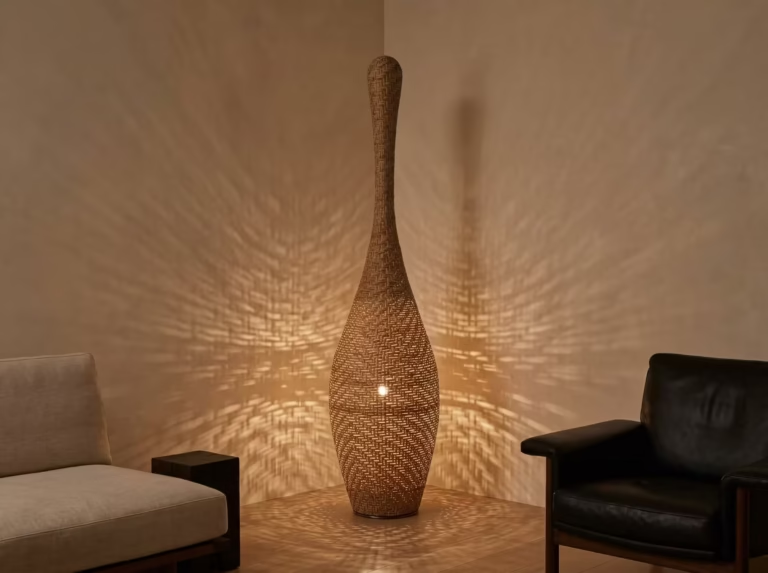
The Bolla XL is less a lamp than a piece of vertical furniture. Its oversized rattan lantern form exists to solve the specific problem of a “dead corner” — the part of a living room or bedroom that goes visually flat once the sun sets. Lit from within, the woven rattan throws a soft, patterned glow through its surface, giving the corner texture and depth rather than a flat wash of light.
Layer Role
Primary: Ambient (foundation, corner-specific). Secondary: Accent, via the shadow pattern cast by the weave itself.
Technical Spec Snapshot
- Materials: Rattan, woven by hand
- Dimensions: Height 225cm, Diameter 56cm (XL configuration)
- Light source: Replaceable, E27 socket, 42W
- Color temperature / CRI: Bulb-dependent — spec target 2200–2700K, 90+ CRI for authentic lantern glow
- Dimming: Dependent on paired dimmable LED bulb and compatible dimmer
Placement & Proportion Rules
- Treat it as furniture: allow at least 18 inches of clearance on all sides so the weave’s shadow pattern has room to project onto adjacent walls and floor.
- Given its scale, reserve it for ceiling heights of 9 feet or greater — in a lower room it will visually dominate rather than anchor.
- Avoid placing a side table directly against it; let it stand alone as the corner’s singular gesture.
Material Pairing Notes
Rattan pairs naturally with linen upholstery, white oak flooring, and warm plaster walls. It also holds up well against a single piece of dark, saturated furniture — a black leather chair or ink-toned rug — where the contrast in material and tone keeps the pairing from feeling like a themed “resort” moment.
To master the glow layer — corner lamps, shade translucency, and warm-dim bulb selection — see our guide on ambient floor lamps and natural-fiber lighting.
Bolla Floor Lamp Extra Large Rattan
by Gervasoni
Rattan
Price at time of publishing· Subject to change
Price at time of publishing· Subject to change
Buyer's Guide & Architectural FAQ
FAQ 1: What dimming controls do I need for integrated LED versus bulb-based fixtures?
The two categories require entirely different diligence.
For integrated LED fixtures — such as the Arco, the Dorian, or the LED configuration of the Tizio — the driver and the light source are matched at the factory. The remaining variable is the wall or in-line dimmer. Confirm the fixture’s published dimming protocol (Dorian, for instance, is triac/CL compatible) and pair it with a dimmer explicitly listed as compatible. A mismatched dimmer on an integrated LED driver produces flicker, buzzing, or a dead zone at the low end of the dial — the fastest way to make an expensive fixture feel cheap.
For bulb-based fixtures — the Real Simple, the Bolla, and standard-configuration Tizio — the dimming outcome depends almost entirely on the bulb chosen, not the fixture itself. Select a dimmable LED bulb from a manufacturer that publishes flicker and compatibility data, and test it on the intended dimmer before committing to a whole-house order.
In a luxury interior, dimming is not a convenience feature. It is the mechanism that allows a single fixture to serve breakfast-bright mornings and quarter-glow evenings — the difference between a room that is simply lit and one that has been composed.
FAQ 2: How do I choose the right scale, height, and span for spatial proportion?
Scale is the most common failure point in residential lighting specification, and it is governed by a small set of consistent rules:
- Ceiling height to fixture height: For floor lamps over 60 inches — the Bolla XL, certain Arco configurations — reserve the piece for ceilings of 9 feet or taller. In an 8-foot room, the same fixture will visually crowd the space rather than anchor it.
- Pendant length to surface length: A linear pendant like the Dorian should span roughly two-thirds the length of the table or island beneath it, centered, never edge to edge.
- Arc reach to seating footprint: An Arco-style floor lamp’s arm should reach the center of the seating or dining moment it’s meant to illuminate — not the geometric center of the room, which is a common and easily corrected mistake.
- Treat oversized pieces as furniture, not accessories: The Bolla XL, at over 7 feet tall, needs the same clearance planning given to an armchair or a console — at least 18 inches of breathing room on all sides.
The unifying principle: a fixture should relate to the object or zone it serves, not to the abstract volume of the room.
FAQ 3: What Kelvin and CRI should I specify for a "quiet luxury" aesthetic?
Two numbers govern how honest and how warm a room’s light will feel.
Kelvin consistency matters more than any single fixture’s individual temperature. In an open-plan space, mixing a 2700K lamp with a 4000K recessed can will produce two visibly different “zones” of light, and the eye will register this as unresolved rather than intentional. For residential luxury interiors, 2700K–3000K across all fixtures is the standard that reads as warm without veering amber.
CRI (Color Rendering Index) determines whether that warm light renders material honestly. A CRI below 85 will mute the veining in a travertine base or dull the tone of a wood floor. 90+ CRI is the minimum threshold for any room where stone, textiles, art, or skin tone need to render accurately — which, in practice, is every room in a well-considered home. Fixtures with integrated LED, such as the Arco (93 CRI) and Dorian (90 CRI), already meet this standard at the factory. For bulb-based fixtures like the Real Simple and Bolla, CRI must be written into the specification sheet — it will not be included by default with a standard hardware-store bulb.
FAQ 4: How do I harmonize mixed materials — stone, metal, and rattan — without the room feeling themed?
Material harmony in lighting follows the same logic as material harmony in furniture: repetition with restraint.
- Choose a dominant temperature family first. Decide whether the room leans toward warm stone and warm metals (travertine, brass, walnut) or a cooler mix (blackened steel, honed limestone) — then let every lighting fixture’s finish and Kelvin output support that choice rather than introduce a competing one.
- Let warm light do the bridging work. A travertine base like the Kibun reads more expensive under a controlled, warm, glare-free source; the same is true of rattan on the Bolla. Cool or overly bright light flattens both materials and makes them look like props rather than craft.
- Repeat one material cue exactly twice. If travertine appears in a table lamp, echo it once more — a console, a bathroom surface — rather than introducing four different stones across one floor. The repetition reads as intentional; a single, unrepeated instance of each material reads as accumulated rather than composed.
- Vary silhouette, not palette. A room can hold an arc lamp, a lantern, and a linear pendant simultaneously without feeling cluttered, provided their materials and light temperature belong to the same family. Silhouette diversity photographs as curation; material diversity photographs as inconsistency.
The rooms that read as effortlessly layered are rarely the ones with the most expensive single fixture — they are the ones where every light source, regardless of price point, was specified to agree with the ones around it.