
Outdoor Sectional Ideas: Luxury Furniture That Feels Like an Indoor Living Room
By Mabrouk Mhamdi · Curator at Apex Illume
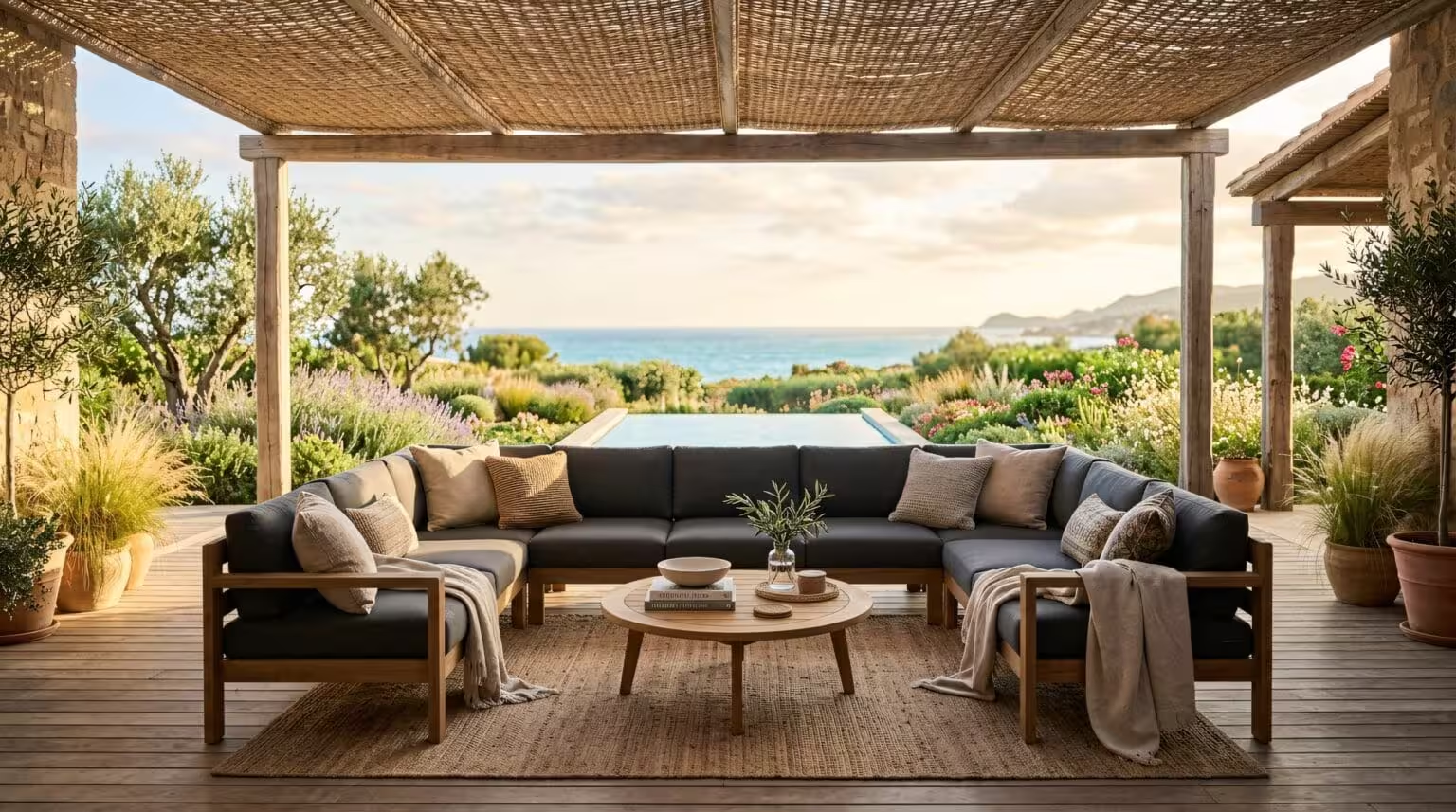
Dusk settles slowly over the patio. String lights warm from a whisper to a glow. And there, deep enough to sink into as if it never left the living room, sits a sectional that has quietly erased the line between indoors and out.
The best outdoor spaces don’t feel like an extension of the house. They feel like a continuation of its comfort — the same ease, the same softness underfoot, simply relocated beneath open sky. This is the standard a true outdoor sectional should meet, and it starts long before the cushions ever get chosen.
“Apex Illume is reader-supported. When you purchase through links on our site, we may earn an affiliate commission at no extra cost to you.”
How We Chose These Outdoor Sectional Ideas
A patio sectional earns its place when it stops feeling like outdoor furniture altogether. For this guide, I prioritized pieces and materials that hold an indoor standard outside: frames with real structural confidence (teak, powder-coated aluminum, HDPE, all-weather weave), cushion systems designed to recover after weather (quick-dry constructions and performance-grade fabrics), and silhouettes that still read composed once they’re lived in—pillows shifted, throws tossed, evenings stretched late.
When specific products are featured, they’re chosen for a combination of durability signals, livability, and design restraint—not for novelty, and not for volume.
Choosing a Configuration — L-Shape, U-Shape, Curved, or Modular
Shape determines how a patio feels before a single fabric or finish enters the conversation.
L-Shapes for Defined Corners and Easy Flow
An L-shaped sectional defines a corner of the patio without closing it off, leaving clear sightlines to the yard, pool, or garden beyond. It remains the most versatile shape for mid-sized outdoor spaces.
U-Shapes for Maximum Hosting Capacity
A U-shape wraps seating on three sides, maximizing capacity for larger gatherings. It suits patios built around hosting rather than quiet solo evenings.
Curved Sectionals for Conversation-First Layouts
A gently curved sectional draws every seat inward, toward the center of conversation rather than out toward the view. It’s the shape of choice for spaces designed around connection first, scenery second.
Modular Pieces for Adaptable Footprints
Modular sections can be rearranged as needs shift — expanded for a party, condensed for a quiet weekend. This flexibility makes them a smart long-term investment for evolving outdoor spaces.
Best Materials for a Weatherproof-Luxury Sectional
Material is where “outdoor furniture” either graduates into genuine luxury or reveals itself as a compromise.
Teak for Timeless Patina and Longevity
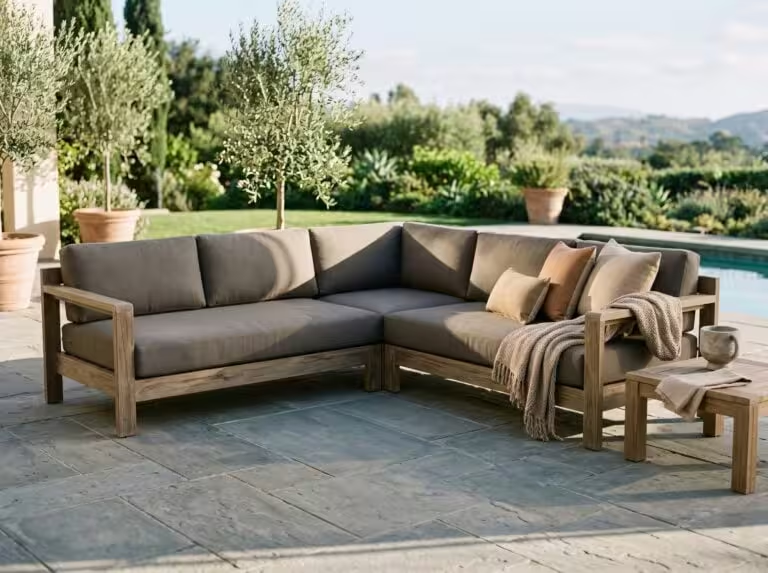
Teak ages into a soft, silvery patina that looks intentional rather than worn — a material that improves with weather rather than merely surviving it. The Haven 4-Piece Teak Outdoor Sectional With Sunbrella Cushions built its entire identity around this quality: a solid teak frame in a modular L-shape configuration, paired with Sunbrella cushions available in Coal, Canvas, Leaf, or Rust. Priced at $6,470 through Perigold, it’s the anchor piece for anyone who wants a patio to feel as substantial as the living room it’s replacing.
Pros
- Solid teak structure that ages into a patina that looks intentional, not tired.
- Sunbrella cushions: the kind of performance fabric that doesn’t collapse after one season of sun.
- Modular L-shape logic that makes the patio feel “zoned” without feeling closed in.
Cons
- Teak is graceful, but it isn’t zero-care—expect weathering, and decide if you want to maintain the original tone or let it silver.
- A substantial footprint; it needs breathing room to feel like luxury, not crowding.
Who it’s for
- Anyone trying to make an outdoor space feel like a true second living room.
- Patios where material integrity matters as much as the look.
- Hosts who want a layout that naturally holds conversation.
Who shouldn’t buy
- If you want featherlight furniture you can move constantly without effort.
- If your patio is fully exposed year-round and you don’t want to think about covers or seasonal care.
- If you need a tight, balcony-scale footprint.
Placement guidance
- Give the sectional a “front yard” of space: keep 30–36 inches clear for circulation along the open side.
- Anchor it with an outdoor rug sized large enough that the front legs sit comfortably on it—this is what makes it read “indoor.”
- If pairing with a fire pit, keep at least 3 feet between heat source and seating.
Haven 4-Piece Teak Outdoor Sectional With Sunbrella Cushions
by Neighbor
Solid teak frame in a modular L configuration with Sunbrella cushion options in understated neutrals.
Price at time of publishing· Subject to change
US only
Aluminum for Lightweight, Low-Maintenance Durability
Powder-coated aluminum resists rust and requires virtually no upkeep, making it a dependable frame material for climates with heavy rain or coastal salt air. Its lighter weight also makes reconfiguring modular pieces far easier.
HDPE "Polywood" for Worry-Free Weather Resistance
HDPE lumber, often marketed as “Polywood,” resists fading, cracking, and moisture damage almost entirely — a material built for owners who want zero-maintenance durability without sacrificing a finished, furniture-grade look.
All-Weather Wicker for Texture and Warmth
Synthetic wicker brings a woven, textural warmth that feels more residential than industrial. It performs well in most climates, though it benefits from covered storage in areas with harsh winters.
Outdoor Cushion Fabrics and Fills That Actually Last
A sectional’s frame may survive the elements, but its cushions determine whether it stays comfortable through them.
Solution-Dyed Acrylic for Fade Resistance
Solution-dyed acrylic fabrics like Sunbrella carry their color all the way through each fiber, resisting UV fading in a way surface-dyed fabrics simply can’t match. This is the fabric technology behind long-lasting outdoor color — precisely why the Haven sectional’s Sunbrella cushions hold their tone season after season.
Quick-Dry Reticulated Foam for Comfort After Rain
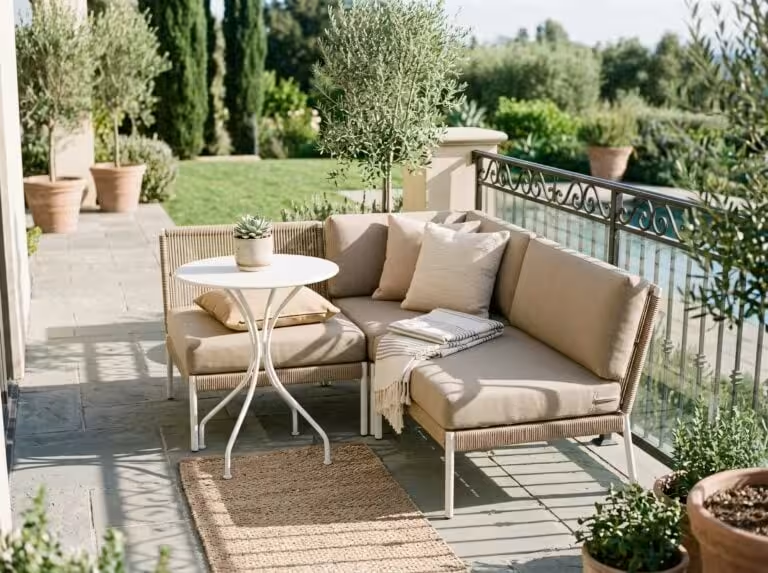
Reticulated foam’s open-cell structure allows water to pass through rather than pool, so cushions dry within hours rather than days after a storm. The Kodo Modular Outdoor 2 Seater Sofa uses exactly this technology — Quick Dry Foam cushions set into a powder-coated aluminum frame wrapped in polypropylene rope. Priced at $5,555 through Lumens, it’s designed as a modular piece meant to connect with matching corner and center units, letting the sectional grow as hosting needs do.
Pros
- Quick-dry cushion logic that respects real weather, not ideal weather.
- Modular system thinking: it can start small and expand without forcing a full commitment upfront.
- A balance of structure and texture—rope detail adds warmth without looking overly casual.
Cons
- Modular systems only look effortless when the layout is deliberate; “add-ons later” still require a plan.
- Rope/textural frames are beautiful, but they ask for occasional cleaning to stay crisp.
Who it’s for
- Homes that host sometimes—not always—and need flexibility.
- Smaller patios that want “sectional comfort” without the full sectional footprint on day one.
- Anyone who wants cushions that recover quickly after rain.
Who shouldn’t buy
- If you want a fixed, set-it-once sectional and never think about rearranging again.
- If your outdoor space gets heavy debris (trees/pollen) and you don’t want texture that needs attention.
Placement guidance
- Treat it like a module, not a final answer: leave space on at least one side so future pieces can connect cleanly.
- Keep a small side table within easy reach; modular seating gets used more when there’s a place for a drink and a book.
Kodo Modular Outdoor 2 Seater Sofa
by Studio Segers for Vincent Sheppard
Powder‑coated aluminum frame wrapped in polypropylene rope with Quick Dry Foam cushions; modular piece designed to gang with matching corner/center units.
Price at time of publishing· Subject to change
Price at time of publishing· Subject to change
Small-Space Outdoor Sectional Ideas That Preserve Flow
A small patio or balcony doesn’t rule out a sectional — it simply calls for a more deliberate footprint.
Compact Modules for Balconies and Narrow Decks
Individual modular pieces, like the Kodo 2 Seater Sofa, allow a small space to start with just one or two sections rather than committing to a full sectional’s footprint from day one.
Corner Placements That Free Up Walkways
Anchoring a sectional into a corner rather than floating it centrally preserves the maximum amount of usable walkway — essential on a narrow deck or balcony where every foot of clearance counts.
Leggy Silhouettes for Screened Porches
A sectional raised on visible legs, rather than a solid base, keeps a screened porch feeling open and airy rather than boxed in by furniture.
Placement Guidance: How to Make a Sectional Feel Effortless Outdoors
A sectional should never feel like it was “fit” into a patio. It should feel like the patio was always meant for it.
- Keep circulation honest: preserve 30–36 inches of clear path where people naturally walk.
- Let the view stay open: L-shapes work best when the open side faces the yard/pool/garden—space feels larger when sightlines aren’t blocked.
- Respect the table distance: leave 14–18 inches between the seat edge and a coffee table so legs can move without constant adjustments.
- Use one anchor layer: an outdoor rug or a centered coffee table keeps modular arrangements from drifting visually.
Fire Pit + Sectional Layouts That Stay Cozy and Safe
A fire pit transforms a patio into a destination, but only if the seating around it respects both comfort and safety.
Clearance Guidelines Around Heat Sources
Maintain a minimum of three feet between any seating and a fire pit’s edge, both for safety and for comfortable heat exposure that doesn’t force guests to scoot back mid-conversation.
Shapes That Wrap a Fire Pit Without Crowding It
Curved or modular configurations wrap naturally around a circular fire pit, keeping every seat within easy conversation distance without anyone facing directly into smoke or excessive heat.
When to Swap in a Coffee Table Instead
On evenings without a fire lit, or in setups without a built-in pit, a generously scaled coffee table can anchor the same conversation-first layout — proof that the sectional’s arrangement matters more than the heat source itself.
Covered vs. Uncovered Patios — Protection and Care
The right care routine depends entirely on how exposed a sectional lives.
Do You Need Furniture Covers or Storage
Uncovered patios benefit significantly from fitted furniture covers during off-season months, or full storage where winters bring snow and ice. Covered patios still benefit from occasional protection during wind-driven rain, though the need is far less constant.
Cleaning and Maintaining Outdoor Cushions
A simple mixture of mild soap and water, applied with a soft brush, keeps solution-dyed fabrics like Sunbrella looking fresh. Regular cleaning — rather than waiting for visible buildup — extends cushion life considerably.
Styling Your Outdoor Sectional Like an Open-Air Living Room
Once the sectional is chosen, styling is what completes the illusion that the living room simply continued outside.
Anchoring the Space With a Rug
An outdoor-rated rug grounds the seating area the same way an indoor rug grounds a living room — defining the space’s edges and softening the transition from hard patio flooring underfoot. A well-placed planter or vessel nearby extends the effect further; see Vase Decorating Ideas (coming soon to the Decor journal) for pairing suggestions suited to outdoor textures.
Layering Pillows and Portable Lighting
Mixed-texture pillows and portable lighting — lanterns, string lights, battery-powered sconces — bring the same layered warmth outdoors that a living room achieves indoors, softening hard frames and extending usability well past sunset.
Finishing Touches That Feel Resort-Level
The details that separate a good patio from a resort-level one are rarely the sectional itself — they’re the layers around it. For a fuller styling framework across every room of the house, the philosophy holds steady: see the How to Layer Home Decor for the complete approach.
Modular Outdoor Sectionals for Flexible Hosting
A modular system is less a single purchase than an evolving investment.
Reconfiguring Seating for Parties and Seasons
Modular pieces can expand into a full U-shape for a summer party, then contract into a simple loveseat configuration for a quiet fall evening — the same investment, endlessly reshaped.
Which Add-On Pieces to Buy First
Start with a corner and one armless section — the minimum footprint for genuine lounging — then expand outward as hosting needs grow. This staged approach lets a modular system like the Kodo Sofa scale naturally over several seasons rather than requiring a full purchase upfront.
FAQs: Outdoor Sectionals
What’s the best material for a luxury outdoor sectional?
Teak is the classic answer for long-view beauty—substantial, weather-friendly, and better with age. For low-maintenance durability in wet or coastal climates, powder-coated aluminum and HDPE (Polywood-style lumber) can be the smarter choice.
Is Sunbrella actually worth it?
When outdoor seating is used often, yes. Solution-dyed acrylic holds color far better than many standard outdoor fabrics and tends to age with fewer visible compromises.
How do I choose between an L-shape and a U-shape?
Choose an L-shape when you want flow and sightlines; choose a U-shape when the patio is primarily a hosting room and you want a layout built around conversation.
How much clearance do I need around an outdoor sectional?
Plan for 30–36 inches of clear walking path along the open edges. Less than that starts to feel like navigating furniture instead of living around it.
Can I leave outdoor cushions outside in the rain?
Some can handle it, but “rain-tolerant” isn’t the same as “always comfortable.” Quick-dry constructions recover faster; covers (or a storage strategy) keep cushions feeling indoor-level pleasant.
How far should seating be from a fire pit?
A dependable baseline is 3 feet minimum from the fire pit edge—comfortable heat without forcing guests to lean away mid-conversation.
How do I make an outdoor setup feel like an indoor living room?
Use one strong anchor (rug or coffee table), layer warm light (string lights + a lantern/floor lamp), and keep materials consistent—wood + soft neutrals reads more residential than mixed plastic finishes.
There’s a particular kind of evening that only happens outdoors — string lights holding their glow against a darkening sky, cushions still warm from the afternoon sun, conversation that doesn’t rush inside when the temperature finally drops. A sectional built for this moment doesn’t just survive the elements. It disappears into the comfort of the evening, exactly the way its indoor counterpart always has.
Explore the pieces we return to again and again, and let the patio become the room no one wants to leave.
About the author
Mabrouk Mhamdi is the curator behind Apex Illume, an independent editorial guide to refined minimalist interiors—focused on lighting, seating, and décor chosen for proportion, materiality, and long-view design. Recommendations are research-based and selected to reduce decision fatigue with a tighter, more considered edit.