
Shelf Styling Ideas: How to Edit and Arrange a Bookshelf Like a Designer
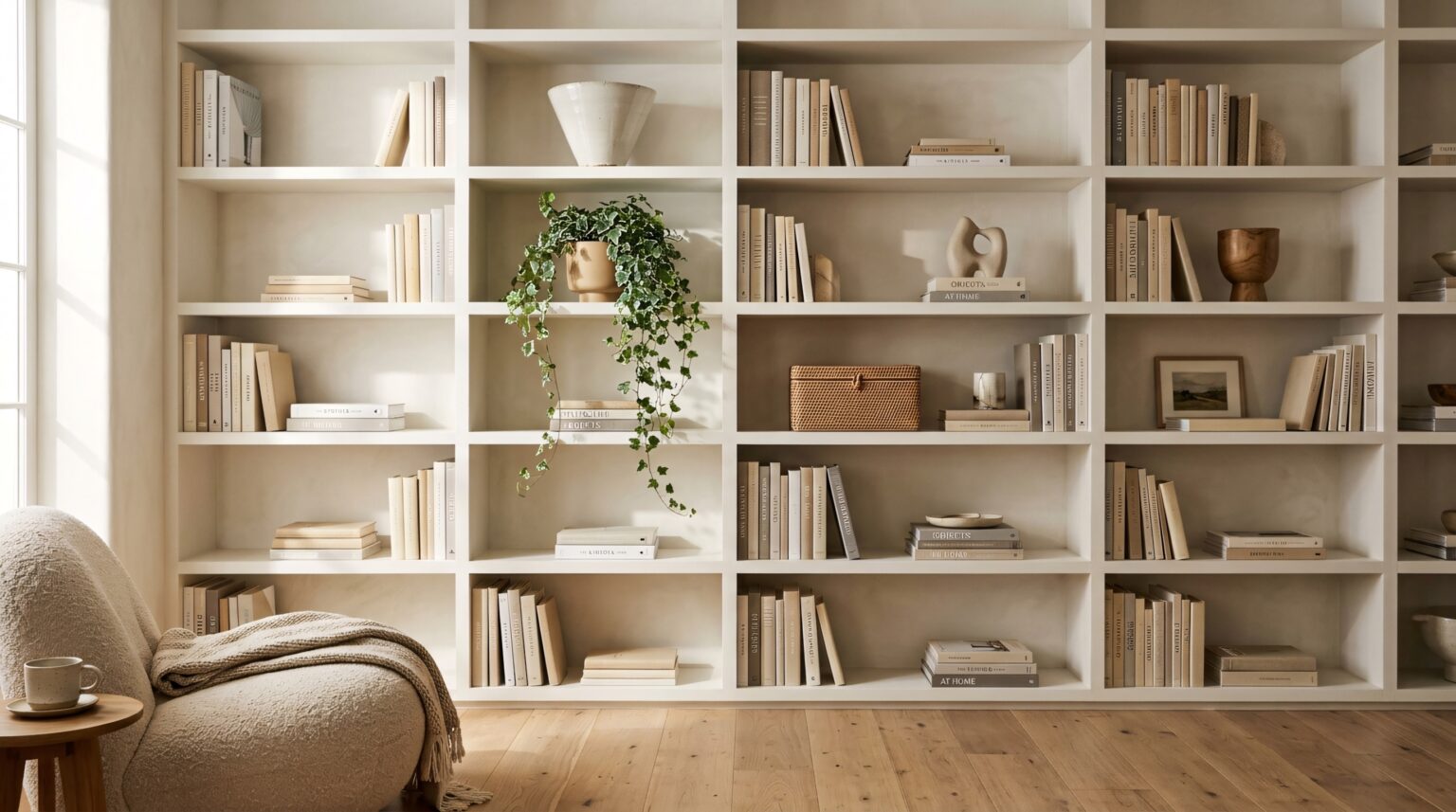
A single trailing plant catches the afternoon light. Books lean at just the right imperfect angle, spines mismatched but somehow harmonious. A ceramic vessel holds its own quiet corner, asking for nothing more than to be looked at. The whole arrangement looks as though it gathered itself slowly, over a decade of travel and taste — never all at once, never from a single shopping trip.
This is what a shelf can be: a small autobiography on display. And yet most shelves never get the chance, because most people fill them before they’ve learned to edit at all. The difference between a shelf that feels collected and one that feels cluttered isn’t more objects. It’s restraint.
“Apex Illume is reader-supported. When you purchase through links on our site, we may earn an affiliate commission at no extra cost to you.”
How to Style Shelves Without Looking Cluttered
The instinct with an empty shelf is almost always to fill it. The better instinct is to leave it alone, at least in part.
The Edit-and-Breathe Method Explained
Start by placing every object you’re considering on the shelf, then remove a third of them. What remains should feel intentional, not sparse — that one edit resolves more shelves than any styling formula that follows it.
Negative Space Targets That Keep Shelves Calm
Aim for roughly 30 to 40 percent visible negative space across a shelf’s surface — enough breathing room to let the eye rest between objects, rather than scanning a solid wall of stuff.
The Designer Formula for a Collected Look
Once the editing is done, a simple formula governs how the remaining pieces come together.
Height Variation That Guides the Eye
Group objects of varying heights rather than lining up everything at the same level. A tall vase beside a low stack of books beside a mid-height object creates a visual rhythm the eye naturally follows.
Odd-Number Groupings and Why They Work
Groupings of three tend to feel more intentional than pairs or even numbers — the asymmetry feels natural rather than staged, echoing the same logic that governs a well-set table or a thoughtfully arranged gallery wall.
Mixing Categories Without Losing Cohesion
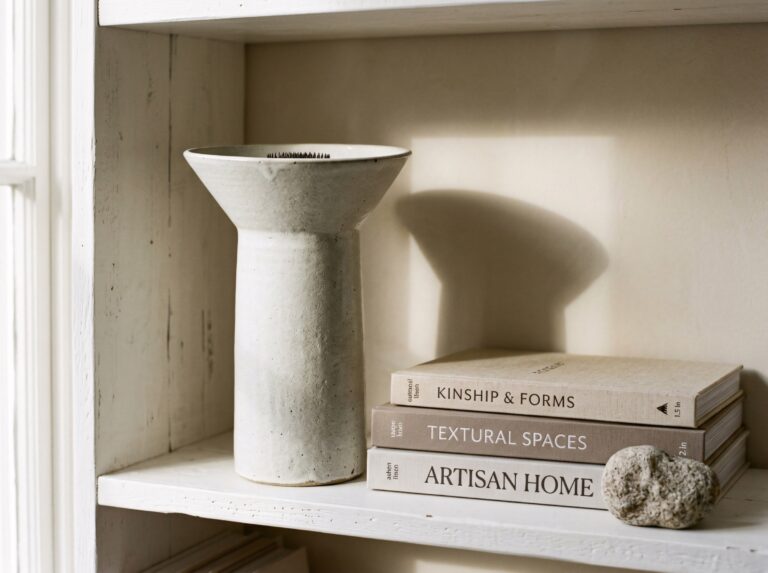
The most successful shelves mix books, objects, art, and greenery rather than committing fully to any one category. A single striking piece — like the Hana Vase in Ashen from Audo Copenhagen — can anchor an entire grouping on its own. Its glazed stoneware finish, cylindrical base, and wide cone-shaped rim give it a sculptural presence that holds its own beside a stack of books or a scattering of smaller objects, and the included kenzan flower frog means it doubles as a place to rest a single stem when the mood calls for it. Priced at $226 through Finnish Design Shop, it’s the kind of piece a shelf doesn’t need many of — just one, placed well.
Hana Vase in Ashen
Krøyer-Sætter-Lassen
Glazed stoneware vase in off-white (“ashen”) with a cylindrical base and wide cone-shaped rim; includes a removable kenzan flower frog.
Built-Ins vs. Floating Shelves vs. Bookcases
Not every shelf carries the same structural allowances, and styling should shift accordingly.
Lighter Loads for Floating Shelves
Floating shelves typically support less weight than built-ins or freestanding units, so styling should favor lighter objects — smaller vessels, a handful of books, nothing that risks testing the shelf’s limits over time.
Deeper Styling and Leaned Art for Built-Ins
Built-in shelving generally allows for greater depth, which opens the door to layered styling — a leaned piece of art at the back, objects arranged in front of it, creating dimension a shallower shelf can’t support.
Freestanding Bookcases and Their Flexibility
A freestanding bookcase offers the most flexibility of the three, since it can be relocated, reconfigured, or restyled entirely without touching the walls — a practical advantage for renters or anyone who likes to rearrange.
Kitchen Open-Shelf Styling That Survives Daily Use
A kitchen shelf answers to a different standard than one in a living room — it has to survive daily use, not just look good in photographs.
Wipeable Materials for High-Use Zones
Stoneware, glass, and sealed wood hold up far better near a stove or sink than porous or delicate materials, which can absorb grease and odor over time.
Logical Zones for Reach and Airflow
Group items by function — everyday dishware within easy reach, décor pieces slightly higher or further back — so the shelf stays both usable and visually organized.
Spacing That Keeps Cleanup Easy
Leave enough space between objects for a hand and a cloth to pass through comfortably. A shelf styled too tightly becomes a shelf nobody wants to clean, which defeats its daily purpose entirely.
Cozy Living-Room Shelf Styling With Warm Neutrals
A living-room shelf can lean fully into mood, since its job is comfort rather than daily function.
A Restrained Palette for a Calm Feel
Limiting a shelf’s color palette to two or three warm neutral tones — cream, walnut, aged brass — creates a sense of calm that a busier palette can’t achieve, no matter how beautiful the individual objects are.
Texture as the Main Visual Interest
With color restrained, texture becomes the shelf’s primary source of visual interest — the nubby weave of a basket beside the smooth glaze of a vase, the rough page-edges of a book stack beside a mirrored frame.
Picture Lights and Lamps That Set the Mood
A living-room shelf often sits near a favorite reading spot, and the two naturally style well together — a shelf within arm’s reach of a well-chosen seat, like the setups explored in Best Reading Chair. Lighting deepens the mood further: a small architectural desk lamp tucked onto the shelf itself adds a warm, focused glow, detailed further in Architectural Desk Lamps, while a corner shelf without direct light benefits from the softer wash covered in Ambient Corner Lighting.
Small-Entryway and Apartment Shelf Ideas
Limited square footage doesn’t mean a shelf can’t be styled — it simply narrows the margin for error.
Leaning Into Verticality
In a small footprint, a tall, narrow shelf makes better use of available space than a wide, shallow one — drawing the eye upward rather than asking for square footage the room doesn’t have.
Keeping a Tight, Cohesive Color Palette
A small shelf feels more polished when its color palette stays especially tight — even more so than in a larger room, where a wider palette has more space to resolve itself visually.
Closed Baskets That Hide Everyday Essentials
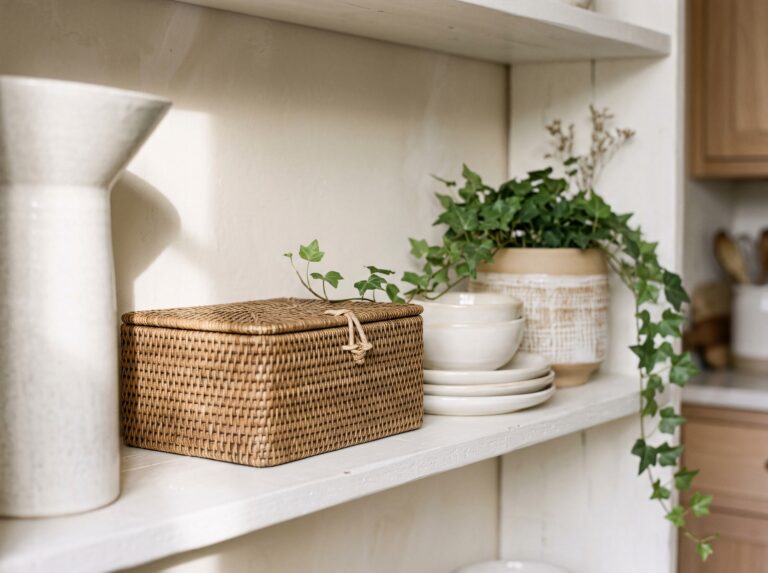
Everyday clutter — mail, chargers, keys — needs somewhere to disappear to, and a closed basket solves this without breaking the shelf’s visual calm. The Rattan Decorative Basket from Matahari US does exactly this, its handmade rectangular silhouette and removable lid offering concealed storage in a warm Antique Brown finish that feels like styling rather than utility. At $85 through Perigold, it’s a small footprint solution — just 14 inches wide — for a real, recurring small-space problem.
Rattan Decorative Basket
Matahari US
Handmade rectangular rattan box with a removable lid in Antique Brown finish; 4″ H x 14″ W x 6″ D.
Plant-Forward Shelf Styling for Movement and Softness
Greenery brings a shelf to life in a way no static object can replicate.
Where to Place Plants for Height and Drama
A single plant placed at one end of a shelf, rather than centered, creates asymmetry that feels more natural and less staged than a perfectly centered arrangement.
Trailing Varieties That Add Softness
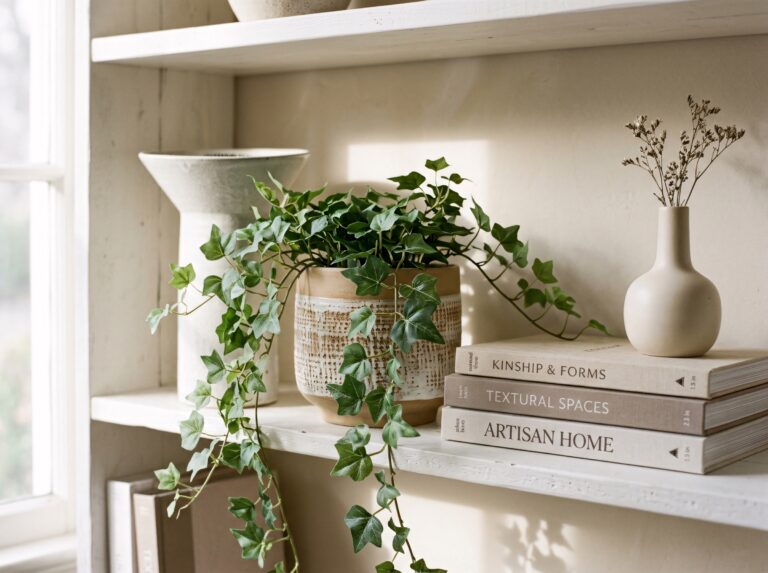
Trailing greenery softens a shelf’s hard edges and adds a sense of movement as it cascades over the front lip. For shelves in lower-light spots or for anyone who prefers not to manage a watering schedule, the Mayna Faux Ivy Plant in Ceramic Pot offers a convincing substitute — polysilk ivy with genuinely trailing stems, set in a tan-and-white ceramic pot. At 15 inches tall and 34 inches wide, it’s sized to drape generously over a shelf’s edge. Priced at $132 through Perigold, it delivers the organic movement of a live plant without the maintenance.
Mayna Faux Ivy Plant in Ceramic Pot
Creative Displays, Inc.
Artificial polysilk ivy with trailing stems in a tan/white ceramic pot; overall 15″ H x 34″ W x 27″ D.
Practical Light and Water Considerations
For real greenery, match the plant variety to the shelf’s actual light exposure rather than the light you wish it had — a low-light corner will never sustain a sun-loving plant no matter how carefully it’s watered.
A Seasonal Swap System for Effortless Refreshing
A well-styled shelf shouldn’t require a full overhaul every few months. It should simply flex.
Building a Durable Base Arrangement
Establish a core arrangement — vase, books, one or two anchor objects — that stays in place year-round, doing the heavy lifting so seasonal changes stay light and quick.
Rotating Pieces Without Rebuying
Swap three to five smaller pieces by color or theme to mark a season or a shift in mood — a few pinecones in autumn, a bowl of citrus in winter, nothing that requires touching the base arrangement at all. The result is a shelf that feels current without ever asking for a full rebuild.
There’s a particular satisfaction in a shelf finished not by filling every inch, but by knowing exactly when to stop — negative space left intact, one striking object given room to breathe, a trailing plant allowed to simply hang there, unbothered. It becomes less a display and more a portrait, quietly updating itself as the room around it changes.
Explore the pieces we return to again and again, and let your shelves tell a story that took time to arrive at.