
Comfortable Accent Chairs for the Living Room: The Designer's Comfort Checklist
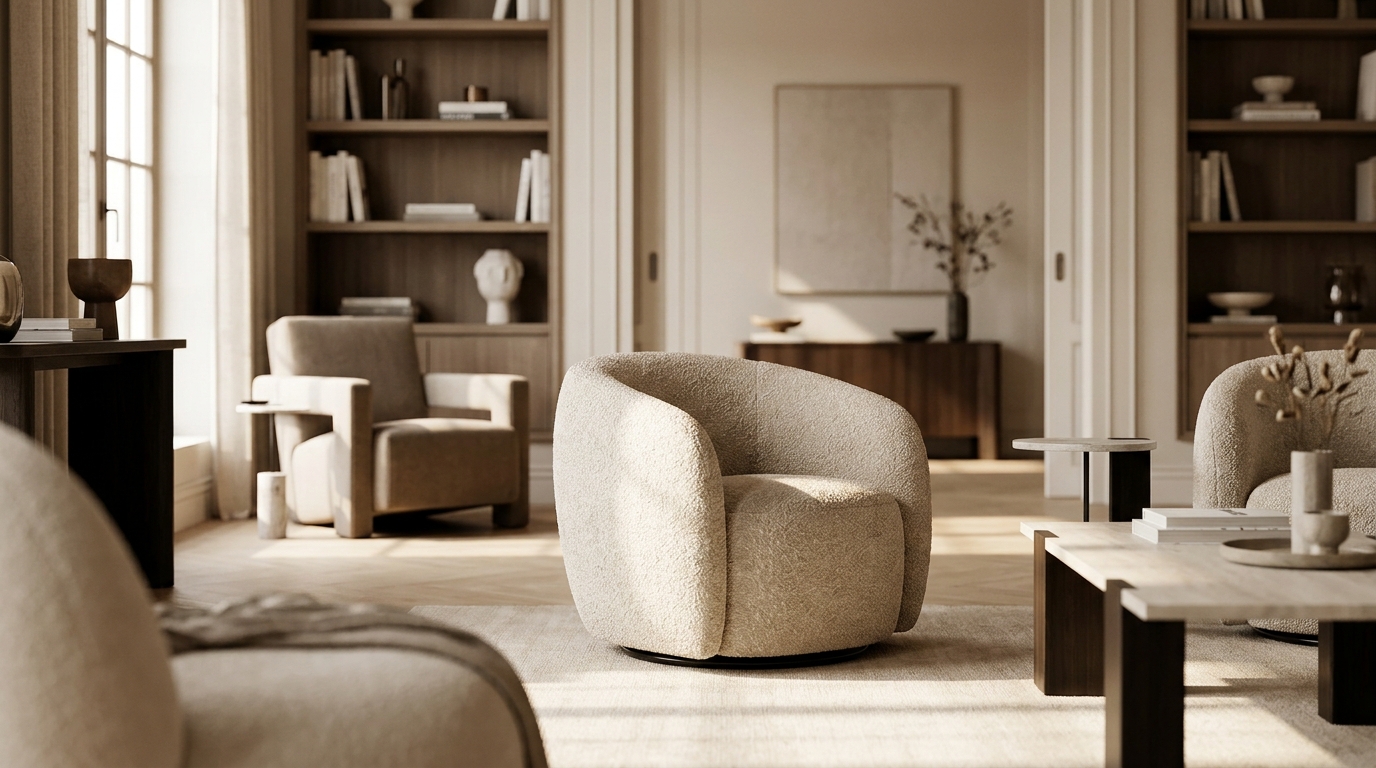
There is a particular kind of disappointment reserved for the beautiful chair no one ever sits in. It photographs well. It anchors a corner with quiet authority. And then, somehow, it becomes furniture in the truest, saddest sense of the word — an object rather than an experience. The best accent chairs never suffer this fate. They are chosen not just for the silhouette they cut against a room, but for the way they receive a body at the end of a long day. This is a guide to that second, quieter kind of beauty: comfort as a design decision, not an afterthought.
“Apex Illume is reader-supported. When you purchase through links on our site, we may earn an affiliate commission at no extra cost to you.”
The Anatomy of True Comfort
Before fabric, before finish, before anything the eye registers first, comfort begins with architecture — the invisible measurements that determine whether a chair holds you or merely contains you. Seat height matters more than most buyers realize; a seat too low forces an awkward rise, while one too high leaves feet dangling, undermining the sense of ease a chair is meant to provide. Seat depth follows close behind. A chair with insufficient depth can feel perch-like, unfinished, while excessive depth strands shorter frames without back support.
Then there is the back itself — its recline, its give, the way it meets the curve of a spine rather than fighting it. Armrests, too often treated as decorative flourishes, do real work: positioned correctly, they support the elbows during long conversations or quiet reading; positioned poorly, they become obstacles. A truly comfortable chair is, in this sense, closer to a piece of engineering than an object of taste. Taste simply happens to be what carries it into the room.
Fabric as a Feeling, Not Just a Finish
Texture is where comfort becomes tactile, where a chair moves from something you look at to something you want to touch. Bouclé remains a favorite for good reason — its looped, nubby weave reads as inviting even from across a room, and it wears beautifully over years of use. Performance velvet offers a different kind of indulgence: a plush hand that feels luxurious while standing up to the demands of an actual, lived-in household. Leather brings coolness and structure, aging into character rather than fatigue. Linen blends, meanwhile, offer breathability and a relaxed drape that suits sun-filled rooms.
The real question is not which fabric performs best in isolation, but which one performs best against your life. A home with children or pets benefits enormously from performance-grade textiles — fabrics engineered to resist stains without sacrificing softness. A quieter, more deliberate household might prioritize the sensory richness of natural fibers instead. Either way, fabric should be chosen the way one chooses company: for how it feels to be close to it, every day.
The Sit-Test: How to Know Before You Commit
No specification sheet can replace the act of sitting. If shopping in person, give the chair at least sixty full seconds — long enough for the initial impression to fade and the true structure beneath the upholstery to reveal itself. Notice where pressure gathers. Notice whether your lower back finds support or empty space.
Shopping online demands a different kind of diligence. Look for cushion fill composition — foam density, spring type, and fill blend all affect long-term comfort far more than a product photo ever could. Fabric durability is measured in double-rub counts, a rating that indicates how many cycles of wear a textile can withstand before showing strain; anything above 15,000 double rubs is generally considered suitable for daily living-room use. These details rarely appear in marketing copy, but they are often listed quietly in the specifications tab — worth the extra scroll.
Swivel or Stationary: Choosing Your Chair's Personality
Not every room asks the same question of its seating. In spaces with a single, obvious focal point — a fireplace, an anchoring piece of art — a stationary chair often makes the more confident statement, holding its position rather than inviting movement. But many living rooms today are pulled in multiple directions at once: a television on one wall, a window view on another, a conversation grouping that shifts depending on the hour. In these multi-focal spaces, a swivel base earns its footprint by refusing to force a choice.
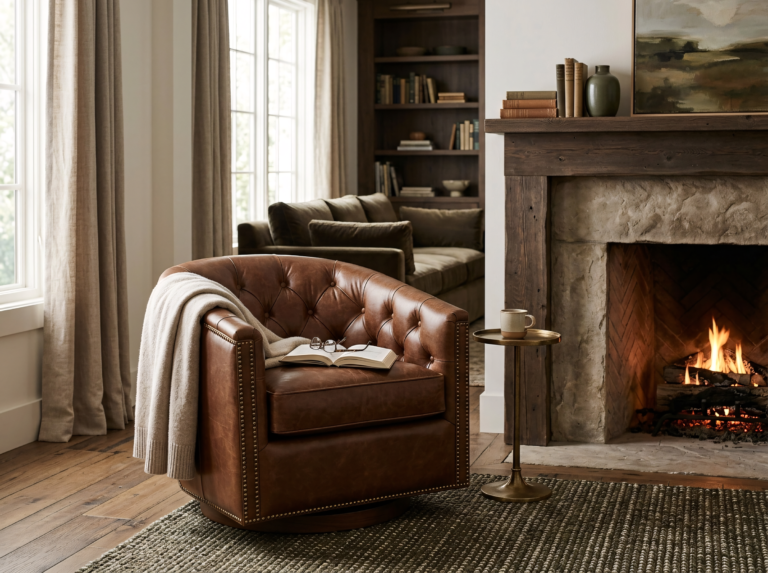
The Maxx Swivel Chair by Four Hands is a study in that flexibility done properly. Structured through the back with tufted detailing and finished nailhead trim along a parawood frame, it reads substantial rather than casual — a chair that can pivot toward the fire in the evening and the window in the morning without ever feeling like it’s compromising on presence. Offered in genuine leather or polyester velvet over a sinuous-spring seat, it manages the rare trick of being both a workhorse and a statement, which is precisely what a demanding, multi-focal room requires.
Maxx Swivel Chair
Four Hands
Parawood base – Genuine leather or polyester velvet upholstery
The Reading Corner: Comfort in Small Doses
Not every accent chair needs to command a room. Some are chosen instead to disappear quietly into a corner, transforming an underused pocket of square footage into the one seat in the house everyone secretly wants. Reading corners have become something of a design obsession lately, and rightly so — there is real luxury in a small, deliberate space built for nothing more than sitting still.
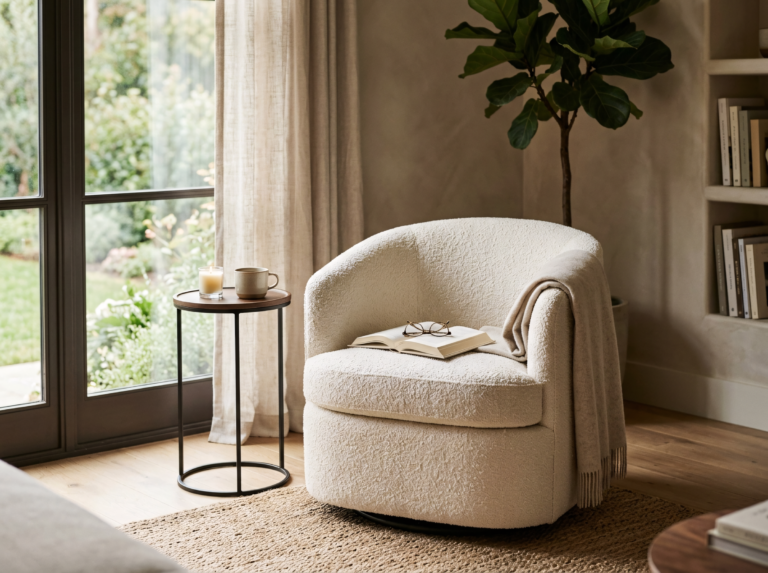
Product Card — Editorial StyleThe Aurora Swivel Chair by Four Hands suits this purpose with unusual precision. At just 26 inches wide, its barrel-style silhouette occupies little visual weight, while a web-suspension seat over a solid-wood frame ensures the compact footprint never comes at comfort’s expense. Upholstered in Knoll Natural bouclé, it brings the tactile softness discussed earlier into a scale that fits even the most modest alcove.
Aurora Swivel Chair
Four Hands
polyester boucle – solid-wood frame
A reading corner, however, is rarely complete with seating alone. The right light transforms a chair from merely present to genuinely inviting — a single well-placed lamp doing as much emotional work as the upholstery itself. For a fuller understanding of how ambient, task, and accent lighting work together to complete a space like this, The Six Pillars of a Luxury Lighting Collection offers the architectural framework this corner deserves.
Placement for Conversation, Not Just Comfort
Comfort is not only a property of the chair — it is a property of where the chair sits. An accent chair angled slightly toward a sofa, rather than facing it head-on, tends to create a more natural conversational geometry, one that invites lingering rather than confrontation. Positioning a chair near a window brings daylight into the seated experience itself, while placing one beside a floor lamp extends its usefulness well into the evening.
Equally important is what a chair should never do: block a natural walking path, however beautiful its placement might otherwise be. The goal is a room that flows as easily as it invites you to sit down within it — comfort, again, expressed architecturally rather than just materially.
Pairing Your Chair With the Room's Larger Story
An accent chair rarely lives in isolation. It exists in conversation with a sofa or sectional, and the most successful pairings share a quiet logic: seat heights that align closely enough to feel intentional, proportions that balance rather than compete, and a relationship between color and texture that reads as considered contrast rather than accident.
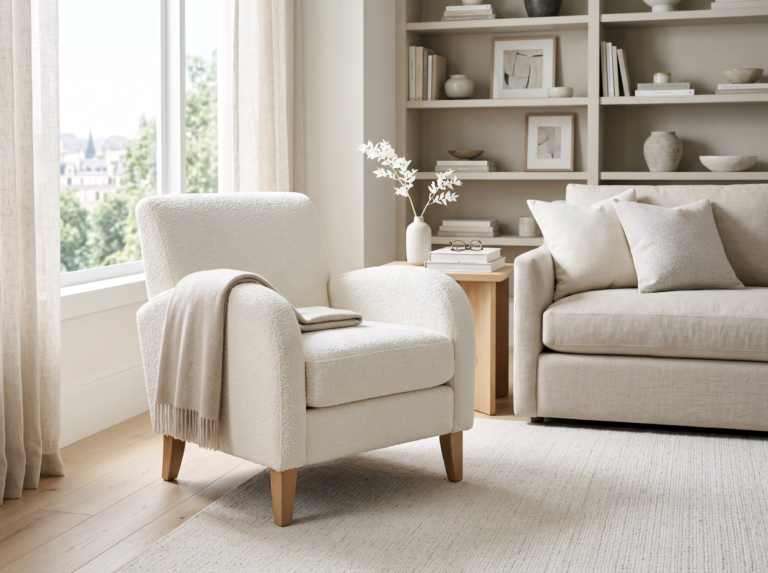
The Brodie Armchair by Four Hands demonstrates this principle with restraint. Its rounded arms and oak-finished legs sit comfortably alongside most sofa silhouettes, while its Sheldon Ivory bouclé upholstery — built over foam and sinuous-spring construction — offers a neutral warmth that pairs rather than competes. It is, in the truest sense, a completing chair: chosen not to steal attention from a room, but to finish a sentence the sofa began.
Brodie Armchair
Four Hands
oak wood – Sheldon Ivory boucle among other fabrics
This is ultimately the deeper truth beneath every measurement, fabric swatch, and swivel mechanism discussed here: an accent chair is never just a chair. It is one voice within a larger, layered composition. For the full philosophy behind building that composition — how furniture, texture, and object work together as a unified whole —How to Layer Home Decor picks up precisely where this comfort checklist leaves off.
A final styling note: when in doubt, test a new chair in its intended spot for a full week before making any final judgment. Rooms reveal their true rhythms slowly, and the right chair often announces itself not on day one, but on the evening you realize you’ve been sitting in it for hours without noticing.